The Society's Uneasy Birth, 1816–1817
The American Colonization Society came into being in December 1816 in Washington, in the drawing rooms and legislative chambers of a capital still fixing its identity, out of a coalition so heterogeneous that historians have never agreed on a single motive to explain it. Robert Finley, a Presbyterian clergyman from New Jersey, is usually credited as the animating spirit, but the founding meetings drew Henry Clay, Bushrod Washington, John Randolph of Roanoke, and Francis Scott Key into common cause with men who, on almost every other question touching slavery, stood at odds with one another (Staudenraus 1961). Some of the Society's founders, Randolph most bluntly among them, wanted a mechanism for removing free Black Americans whose very existence they regarded as a standing incitement to the enslaved; a Virginia slaveholder like Bushrod Washington saw colonization as a safety valve that could draw off manumitted people without threatening the property regime that sustained plantation agriculture. Others, including a number of Quakers and evangelical reformers, viewed colonization as a genuinely humanitarian project, a means by which African Americans, barred by law and custom from full citizenship, might build an autonomous Christian and commercial society on the African coast and, in the process, plant a beachhead against the transatlantic slave trade itself (Staudenraus 1961)(Burin 2005). Free Black communities in Philadelphia, New York, and Baltimore were, from the outset, divided and largely hostile; a mass meeting at Philadelphia's Bethel Church in January 1817, organized by Richard Allen and James Forten, denounced the scheme as an attempt to strengthen slavery by removing its most articulate opponents, and this suspicion never fully dissipated even as thousands of African Americans later concluded that emigration offered more than continued life under Jacksonian America's tightening racial codes (Campbell 1971)(Moses 1996). The Society's dual character — its capacity to be simultaneously an instrument of racial exclusion and a vehicle through which African American settlers might exercise genuine self-determination — was thus present at its founding, and it would shape every decision the organization made about where, and among whom, to plant its colony (Burin 2005)(Clegg 2004).
The Society had no colony, no ship, and no clear plan when it incorporated, and its early years were consumed by fundraising, by petitioning Congress and state legislatures for support, and by a search for scientific and geographic knowledge of the West African coast, about which most of its members knew almost nothing beyond fragments drawn from British abolitionist literature and the recent history of Sierra Leone, the settlement the British had established at Freetown in 1787 and reconstituted under Crown control in 1808 (Shick 1980).
Mills, Burgess, and the 1818 Reconnaissance
To remedy that ignorance, the Society dispatched two agents to reconnoiter the coast in 1818: Samuel J. Mills, a Congregationalist minister who had been instrumental in founding the American Bible Society and who carried into this new venture the same missionary fervor that had earlier sent him seeking a Western outpost for evangelical enterprise, and Ebenezer Burgess, a professor at the University of Vermont. The two men sailed for Sierra Leone in the winter of 1817–1818 and spent several months examining the Freetown settlement, consulting its governor and merchants, and probing southward along the coast toward the Sherbro estuary in search of territory that might be purchased or otherwise obtained for an American colony (Staudenraus 1961). It was in the course of this reconnaissance that Mills and Burgess made contact with John Kizell, a figure whose career would prove indispensable, and finally tragic, to the Society's opening venture.
Kizell had been born in the Sherbro region, enslaved as a child, and taken to South Carolina; he gained his freedom during the Revolutionary War by escaping to British lines, was evacuated with other Black Loyalists to Nova Scotia, and from there joined the 1792 migration of the Nova Scotian settlers to Freetown, where he became a merchant of standing and a leader among the Sierra Leone Black settler community before returning, later, to his natal Sherbro country as a trader with connections among the Sherbro and Vai peoples (Mouser 2010)(Holsoe 1971). Kizell impressed Mills and Burgess as a man uniquely positioned to broker American ambitions on a coast whose political landscape was governed by an intricate lattice of Sherbro, Temne, Bullom, and Vai chieftaincies, by resident Euro-African and Afro-British trading families, and by the residual influence of Sierra Leone's colonial government. Burgess returned to the United States to report favorably on prospects near Sherbro Island; Mills, however, died at sea on the return voyage in June 1818, before he could deliver his own account, and the Society was left to act on Burgess's optimism and on the promises Kizell had seemingly extended regarding land (Staudenraus 1961)(Shick 1980).
The Elizabeth and the Founding Expedition of 1820
More than a year and a half of fundraising, congressional maneuvering, and preparation followed before the Society could mount an actual colonizing expedition. In March 1819 Congress passed the Slave Trade Act, appropriating one hundred thousand dollars and authorizing President James Monroe to establish an agency on the African coast for the reception of Africans rescued from illegally trading slave ships; this federal appropriation, nominally unconnected to the Society's colonization scheme, became in practice its financial lifeline, since the Society's agents were commissioned simultaneously as U.S. government agents for recaptured Africans, blurring from the outset the line between a private colonization project and an arm of federal anti-slave-trade policy (Staudenraus 1961)(Huberich 1947). This entanglement gave the infant colony both resources it could not otherwise have commanded and a legal fiction — that its agents were merely accommodating the government's recaptives — that would later prove convenient when the settlers needed naval protection to acquire land at Cape Mesurado.
The ship Elizabeth sailed from New York on 6 February 1820, carrying eighty-eight African American emigrants — mechanics, farmers, and laborers, along with their families, drawn chiefly from New York, Petersburg, and other communities of free Black Americans who had volunteered for the venture despite the discouragement of men like Forten and Allen — under the charge of three white agents: Samuel Bacon, a Massachusetts-born former army officer and lawyer who held the government commission as agent for recaptured Africans, John P. Bankson, and Samuel A. Crozer (Staudenraus 1961)(Burrowes 2016). The expedition's leadership structure already carried the seed of catastrophe: real authority over the colony's founding was vested in these three white men, notwithstanding the Society's professed goal of establishing Black self-government, and the emigrants themselves had comparatively little voice in the decisions that would determine where they settled and on what terms.
The Elizabeth reached Sierra Leone in March 1820, and the party proceeded to Sherbro Island, where John Kizell had prepared the ground — literally and diplomatically — for their arrival. The site selected, on Kizell's advice, was Campelar (sometimes rendered Campelor or Campalar), a low-lying, marshy location on or near Sherbro Island that Kizell believed could be secured through his own standing with local Sherbro authorities (Mouser 2010)(Huberich 1947). It quickly became apparent that the land had not, in fact, been definitively ceded to the Society, and that the agents' expectations of an orderly transfer of sovereign territory rested on an overly sanguine reading of negotiations that local rulers regarded as far less settled. This uncertainty over Campelar's legal status was compounded by a geography almost perfectly designed to kill newly arrived settlers: the site lay amid mangrove swamp, tidal creeks, and stagnant water, in precisely the sort of environment that nineteenth-century medicine, ignorant of the mosquito vector, associated vaguely with "miasma" but could neither explain nor prevent (Shick 1980).
The Fever and the Collapse of the First Settlement
The consequences were swift and appalling. Within weeks of landing, the emigrants and their agents began falling ill with what contemporaries called the "African fever," almost certainly a combination of falciparum malaria and yellow fever against which the settlers, despite prior exposure to endemic disease environments in the American South, had little acquired immunity to these specific West African strains, while the white agents, entirely unseasoned, proved even more vulnerable (Shick 1980)(Akpan 1973). Samuel Bacon died on 3 May 1820; John Bankson died within days of him; of the three original agents only Samuel Crozer survived the first months, and he too returned to the United States broken in health not long afterward. Mortality among the emigrants during 1820 has been estimated at somewhere between one-fifth and one-third of the original company within the first several months, though the surviving records — fragmentary agency correspondence and the Society's own promotional reports, which had every institutional incentive to minimize the scale of disaster — make precise figures difficult to establish with confidence (Shick 1980)(Staudenraus 1961). What is not in dispute is that the death toll was catastrophic enough to void whatever settlement had been attempted at Campelar and to throw the entire colonizing project into crisis within its first year.
With its agents dead or incapacitated and its land claim never firmly secured, the remnant of the expedition retreated from Sherbro Island to Fourah Bay, near Freetown, in the British colony of Sierra Leone, where the surviving emigrants were housed under the sufferance of the Sierra Leone government through much of the remainder of 1820 (Huberich 1947)(Shick 1980). This retreat to British soil was a humiliating admission that the Society's first independent colonizing effort had failed outright, and it placed the future of American colonization on the coast, at least for the moment, in the hands of an institution — the government at Freetown — that had its own reasons, commercial and political, to be wary of an American rival settlement nearby. John Kizell, whose credibility had been placed most directly at risk by the Campelar debacle, continued to advocate for a renewed effort and to press his Sherbro contacts toward a more solid arrangement, but his standing with the Society's leadership in Washington had been damaged by an outcome for which he bore only partial responsibility; much of the failure lay equally in the agents' inexperience, in the Society's chronic underfunding of medical supplies and provisions, and in the fundamental unreality of expecting eighty-eight recently freed people to construct a viable settlement in a fever-ridden estuary within months of arrival (Mouser 2010).
The Nautilus and the Second Wave of Agents
The Society did not abandon the project. In 1821 it dispatched a second expedition aboard the ship Nautilus, again pairing a fresh cohort of emigrants with a slate of white agents: Ephraim Bacon, brother of the deceased Samuel Bacon, together with Jonathan B. Winn and, arriving somewhat later in the sequence of appointments, Joseph R. Andrus and Christian Wiltberger, the last of whom would go on to serve for years as one of the colony's more durable administrative officers even as agent after agent around him succumbed to fever (Shick 1980)(Huberich 1947). The pattern of the previous year repeated itself with grim regularity: disease struck the newcomers almost immediately upon their arrival on the coast, and within a short span several of the agents were dead or so debilitated that command of the expedition passed rapidly from one hand to another. Joseph Andrus, who had been elevated to the position of principal agent, died in 1821, another casualty of the same fevers that had killed Samuel Bacon and Bankson the year before, a fact that underscored how little the Society's leadership had learned, or could learn given the medical knowledge of the era, about how to protect the men it sent to the coast (Staudenraus 1961).
By mid-1821 the Society's American officers on the ground, including Ephraim Bacon, had joined the Sherbro survivors in concluding that no permanent settlement could safely be built in the low, swampy terrain around Sherbro Island and Campelar, and that a healthier and more defensible site had to be found elsewhere along the coast. This conviction turned attention northward, toward the mouth of the Mesurado River, a peninsula the agents and their informants — again including John Kizell, whose local knowledge remained essential even after the Campelar failure — identified as offering higher ground, a defensible headland, and proximity to a river mouth suitable for commerce, all in an area beyond the immediate reach of Freetown's jurisdiction and therefore more amenable to autonomous American settlement (Huberich 1947)(Shick 1980).
The Cyane, the Anti-Slave-Trade Pretext, and Eli Ayres's Mission
The instrument that finally allowed the Society to translate this ambition into a landed colony was the United States Navy, and specifically the sloop of war USS Cyane, commanded by Captain Robert Field Stockton, which had been cruising the West African coast on anti-slave-trade patrol under the authority Congress had granted through the 1819 appropriation and subsequent instructions to the Navy and to agents for recaptured Africans (Staudenraus 1961)(Huberich 1947). The presence of the Cyane on the coast, and Stockton's willingness to lend the Navy's coercive weight to the Society's land negotiations, exposed the fictive thinness of the distinction the Society had always maintained between its private colonizing mission and the federal government's anti-slave-trade enforcement; in practice the two projects were, from Cape Mesurado's founding onward, fused, with naval force standing behind a nominally voluntary land purchase (Campbell 1971)(Gershoni 1985). Eli Ayres, a physician who had been serving as one of the Society's agents on the coast following the deaths and incapacities of 1820 and 1821, was assigned to negotiate directly for the acquisition of territory at Cape Mesurado, and it was Ayres, working alongside Stockton, who conducted the actual purchase negotiations with the local Dey and Bassa authorities who controlled the peninsula (Huberich 1947)(Shick 1980).
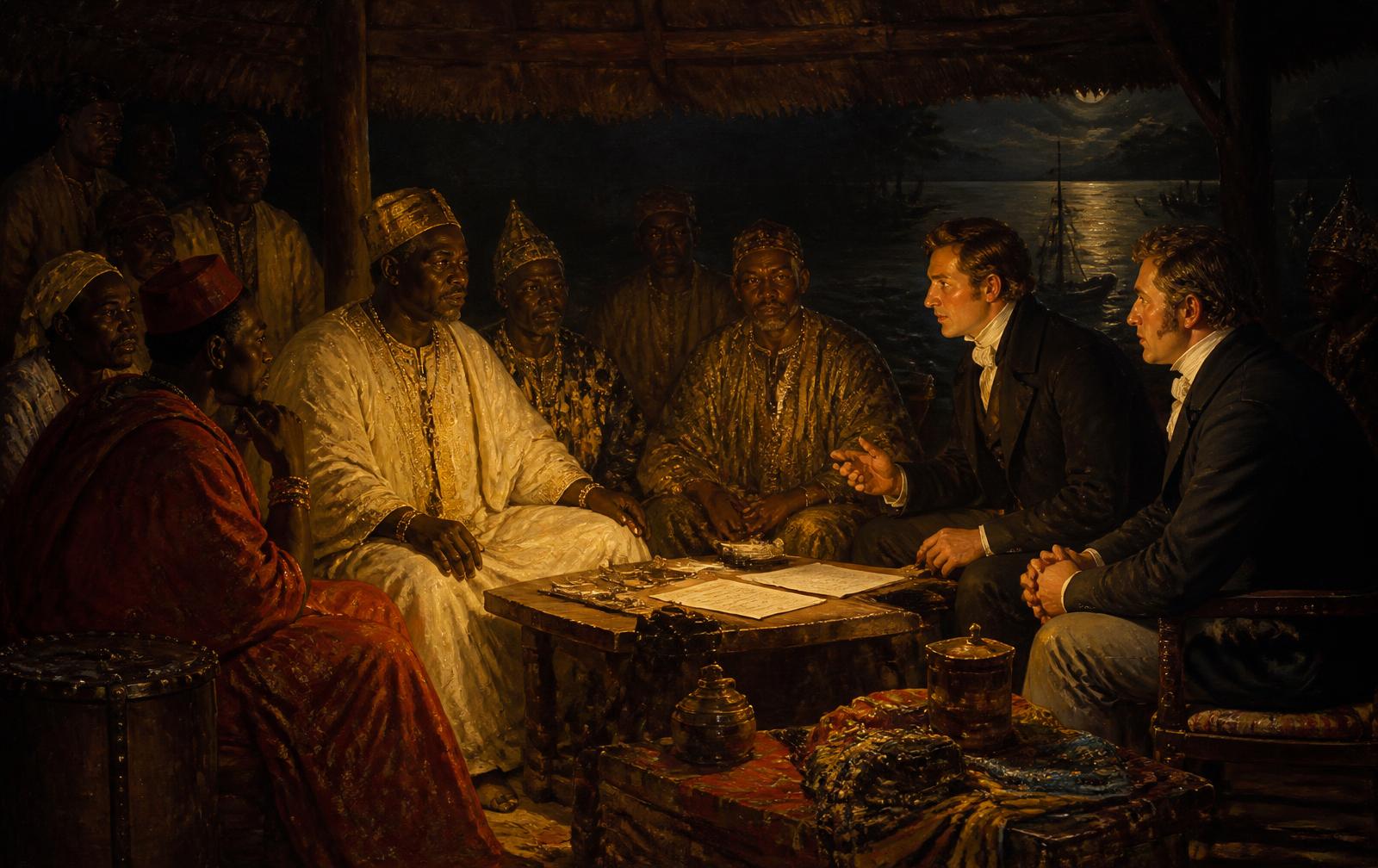
The documentary record of what followed, generally dated to December 1821, has been the subject of sustained historiographical dispute, and no honest account of Liberia's founding can pass over the coercive character of the transaction without qualification. According to the Society's own later narratives and the so-called Cape Mesurado Agreement, King Peter, together with several other Dey and Bassa headmen identified in various accounts as King George, King Zoda, King Long Peter, King Governor, and King Jimmy, agreed to cede a stretch of territory encompassing Cape Mesurado and Dozoa (Bushrod) Island in exchange for a quantity of trade goods — muskets, gunpowder, cloth, tobacco, rum, mirrors, and other manufactured items — whose total value the Society itself later computed at a few hundred dollars, an amount historians agree was grossly disproportionate to the territory's extent even by the standards of contemporary coastal land transactions (Capemesurado 1821)(Huberich 1947). Contemporary and later accounts differ on how far Stockton's naval force was used to coerce King Peter's assent; several narratives, drawing on recollections attributed to participants and to early colonial officials, describe Stockton drawing a pistol on King Peter during the final negotiating session, a detail that, whether or not it occurred in precisely that form, has become emblematic of the broader reality that the agreement was concluded under the shadow of American naval power rather than through anything resembling a negotiation among equals (Huberich 1947)(Shick 1980)(Burrowes 2016). Sierra Leonean and later Liberian oral traditions, as well as some documentary evidence, further suggest that King Peter and his fellow headmen understood the transaction less as an outright cession of sovereignty than as a customary arrangement granting settlers rights of residence and trade in exchange for goods and alliance, an interpretation fundamentally incompatible with the deed of cession the Society's agents recorded and later relied upon to claim permanent, exclusive title (Brooks 1972)(Sawyer 1992). This gap between African customary understandings of land tenure — usufructuary, negotiated, revisable — and the Euro-American legal instrument of permanent alienation that the Society's agents committed to paper constitutes one of the foundational ambiguities of Liberia's origin, an ambiguity that would erupt repeatedly in armed conflict between settlers and indigenous polities over the following decades (Brooks 1972)(Beyan 1991).
Occupation of the Cape and the Precariousness of the New Colony
Even after the December 1821 agreement, the colony's hold on Cape Mesurado remained tenuous through the early months of 1822. The settlers who had straggled through Sherbro Island, Fourah Bay, and the Nautilus expedition were relocated to the Cape only gradually, and Stockton's departure aboard the Cyane left the small settler population without the naval protection that had underwritten the land acquisition in the first place, a vulnerability of which the surrounding Dey, Bassa, and Golah communities, many of whom had never assented to the cession and viewed the new arrivals with open hostility, were fully aware (Huberich 1947)(Akpan 1973). Eli Ayres himself grew doubtful of the settlement's prospects in the weeks after occupation began, at one point apparently favoring withdrawal or relocation in the face of local resistance and continued disease, a hesitation that provoked friction with the emigrant leadership and previewed the pattern, repeated throughout the 1820s, in which the colony's white agents proved more willing than the African American settlers themselves to abandon the Cape Mesurado enterprise under pressure (Shick 1980).
It fell to the settlers who had survived Sherbro Island, Fourah Bay, and the second wave of fever at Mesurado itself to make good, through their own endurance and organization, on a land claim that the Society's agents and the U.S. Navy had extracted through a mixture of trade goods and intimidation but had not themselves secured in any durable sense. The events of 1822 and after — the consolidation of the settlement under Jehudi Ashmun, the armed clashes with neighboring polities, and the slow construction of institutions of self-government — belong to the chapters that follow, but they cannot be understood without reckoning first with the two years of disaster that preceded them: with Samuel Bacon and John Bankson dying within days of landing at Campelar, with Joseph Andrus following them in 1821, with John Kizell's local knowledge proving indispensable yet insufficient to overcome the mismatch between American ambition and Sherbro geography, and with the eventual transfer of that ambition northward to a headland whose acquisition rested on the guns of the Cyane as much as on the goods Eli Ayres laid before King Peter (Ashmun 1826)(Huberich 1947).
The Weight of Contested Evidence
Historians disagree sharply about how to weigh these events. Staudenraus and, following him, much of the older historiography treated the Sherbro failure primarily as a tale of tragic miscalculation — brave agents undone by a hostile disease environment and by the treachery or unreliability of local negotiating partners — a framing that tends to minimize the agency and rationality of Sherbro and Vai leaders who had their own reasons, rooted in longstanding patterns of coastal diplomacy with British, French, and American traders, for hedging their commitments to men whose ultimate intentions remained unclear (Staudenraus 1961). More recent scholarship, drawing on Sierra Leonean and Liberian sources alongside the Society's own archive, has emphasized instead the structural violence embedded in the colonization project from its inception: the willingness of the Society's leadership to treat West African land as available for purchase regardless of the wishes of its inhabitants, the routine deployment of U.S. naval power to enforce land cessions that had never been freely negotiated, and the tendency of the Society's own promotional literature to obscure or minimize both the scale of settler mortality and the coercion used against African rulers (Brooks 1972)(Burin 2005)(Beyan 1991). John Kizell occupies an especially contested place in this historiography: to some he appears as a well-meaning but overconfident intermediary whose attachment to the colonization ideal, forged during his own passage through Nova Scotia and Freetown, blinded him to the practical impossibility of the Campelar site; to others he is a case study in the compromised position occupied by Black Loyalist and Sierra Leonean settlers who found themselves mediating, often at their own communities' expense, between American ambitions and West African sovereignty (Mouser 2010)(Holsoe 1971). Both readings capture something true, and neither should be allowed to dissolve the other: the founding of Liberia at Cape Mesurado was at once an extension of a genuine, self-directed effort by African American emigrants to build an autonomous society beyond the reach of American racism, and an act of dispossession carried out against sovereign African polities under the cover of naval force and the fiction of a voluntary land sale — a duality that the disasters at Sherbro Island, no less than the tense negotiations at the Cape, make impossible to resolve into a single, comfortable narrative (Clegg 2004)(Moses 1996).
The human cost of these two years fell disproportionately, it must be said, on the emigrants themselves rather than on the Society's Washington leadership, who continued to solicit donations and recruit new colonists throughout 1820 and 1821 even as reports of the mounting death toll reached the United States, often in attenuated or euphemistic form designed to sustain public and congressional support for the project (Staudenraus 1961)(Shick 1980). Families who had left Petersburg, New York, and other communities in search of a homeland free from the humiliations of American racial caste arrived instead at Campelar's fever-ridden marshes, and a substantial fraction of them did not live to see the colony's eventual relocation to Cape Mesurado at all. That the survivors persisted — that they moved, buried their dead, and tried again first at Fourah Bay and then, under naval escort, at the mouth of the Mesurado River — testifies to a resilience the Society's own agents rarely credited them with in their official correspondence, and it is that resilience, quite as much as the diplomacy of Ayres and the force of Stockton's guns, that made the settlement of 1822 possible at all (Burrowes 2016)(Akpan 1973).
Notes on Sources
This chapter draws primarily on Staudenraus's institutional history of the American Colonization Society (Staudenraus 1961), Huberich's exhaustive documentary compilation of Liberia's legal and political origins (Huberich 1947), and Shick's demographic and social study of the early settler population (Shick 1980), supplemented by Mouser's and Holsoe's specialized work on John Kizell and the Sherbro-Sierra Leone milieu from which he emerged (Mouser 2010)(Holsoe 1971). The Cape Mesurado Agreement itself survives chiefly through the Society's own transcriptions and later reprintings (Capemesurado 1821), a provenance that necessarily colors its account of King Peter's assent; readers should treat the Society's characterization of a freely negotiated cession with the skepticism that Brooks's and Beyan's work, attentive to indigenous land tenure and oral tradition, encourages (Brooks 1972)(Beyan 1991). Mortality figures for 1820–1821 remain approximate, since surviving records are fragmentary and were compiled by parties with an institutional interest in minimizing the scale of disaster; where sources conflict, this chapter has generally favored the more conservative estimates found in Shick and Akpan while noting the higher figures reported elsewhere (Shick 1980)(Akpan 1973). Broader interpretive framing follows Clegg, Burin, Campbell, and Moses on the mixed motives of colonizationism and Black responses to it (Clegg 2004)(Burin 2005)(Campbell 1971)(Moses 1996).
Reassessing the Founding Coalition's Internal Contradictions
It is worth dwelling further on how thoroughly the Society's founding coalition papered over irreconcilable differences with a shared vocabulary of benevolence, because that vocabulary shaped the instructions given to Bacon, Bankson, Crozer, and later to Ayres and Andrus, and thus shaped the decisions made on the ground at Sherbro Island and Cape Mesurado. Clay's speeches to Congress and to Society meetings emphasized commerce and the "civilizing" of Africa through Christian settlement, a framing that allowed slaveholding congressmen to support colonization as compatible with, rather than corrosive of, the institution of slavery at home (Clegg 2004). Finley and the evangelical wing, by contrast, spoke a language of providence and redemption, casting the African American colonist as an instrument by which Christianity and literacy would be carried back across the Atlantic to a continent the Society's promotional pamphlets described, inaccurately and with considerable condescension, as sunk in darkness (Staudenraus 1961). Free Black leaders who opposed colonization, Forten and Allen foremost among them but joined by others in Baltimore, Richmond, and Washington, read straight through this rhetoric to its practical effect: the removal of the free Black population that slaveholders found most threatening to a slave society premised on the fiction that Blackness and bondage were natural correlates (Campbell 1971)(Moses 1996). Yet even as these leaders organized opposition, a meaningful minority of free African Americans, particularly outside the largest port cities and particularly among those who had experienced the tightening of Black codes in Virginia, Maryland, and the District of Columbia during the 1810s, concluded that emigration, however tainted by the Society's white leadership and mixed motives, offered a more plausible path to landownership, political voice, and physical safety than continued residence in the United States (Burin 2005)(Mcdaniel 1995). It was from this latter constituency, more than from any coherent ideological commitment to Pan-African redemption, that the eighty-eight emigrants who boarded the Elizabeth in February 1820 were largely drawn, and their motives, examined individually through surviving petitions and correspondence, ranged from religious conviction to simple economic desperation to a hard-eyed calculation that no worse fate awaited them on the Sherbro coast than the one closing in on free Black communities in Jacksonian America (Shick 1980)(Mcdaniel 1995).
This heterogeneity of motive among the emigrants themselves has often been flattened in both the Society's triumphal narratives and in later nationalist historiography that cast the Elizabeth's passengers as pioneers animated by a unified vision of African redemption. The documentary record, thin as it is, suggests instead a company of individuals with disparate and sometimes conflicting expectations, some anticipating swift prosperity as farmers and traders on rich Sherbro land, others primarily seeking relief from legal disabilities that barred free Black Americans from testimony against whites, from unrestricted travel, and in many jurisdictions from education (Shick 1980). That such a diverse company was placed, upon arrival, under the near-total authority of three white agents whose own qualifications rested chiefly on political connection and prior government service rather than on any relevant experience of West Africa, tropical medicine, or diplomacy with African polities, made the disasters that followed almost predictable in retrospect, even if they were experienced by contemporaries as an unforeseeable calamity (Huberich 1947).
The Geography and Diplomacy of the Sherbro Coast
The territory around Sherbro Island into which the Elizabeth's passengers were delivered in March 1820 was no terra nullius awaiting settlement but a densely inhabited and politically intricate region whose rulers had, for generations, managed relations with European and American traders through established protocols of gift exchange, tribute, and negotiated rights of residence rather than outright alienation of land (Brooks 1972). The Sherbro estuary had long been a site of both legitimate commerce in camwood, ivory, and agricultural produce and, more darkly, of the residual slave trade that persisted along stretches of the coast despite British and American prohibition, conducted by Euro-African trading families and by some of the same local rulers whom the Society's agents hoped to enlist as partners in an explicitly anti-slave-trade settlement (Mouser 2010). John Kizell's own standing in this world derived precisely from his ability to move between these overlapping spheres: a Sherbro-born man who had absorbed British colonial and evangelical values during his decades in Nova Scotia and Freetown, he returned to his natal region as neither fully insider nor fully outsider, trusted enough by Sherbro chiefs to conduct trade and negotiate on their behalf in dealings with Freetown, yet identified closely enough with the anti-slave-trade, pro-settlement agenda of the Sierra Leone Company and later the American Colonization Society that his loyalties were never entirely unambiguous to either side (Holsoe 1971).
When Kizell assured Mills and Burgess in 1818, and later Bacon, Bankson, and Crozer in 1820, that land at or near Campelar could be secured for an American settlement, he was almost certainly operating within his own understanding of Sherbro land tenure, in which grants of settlement rights to allied outsiders were customary, negotiable, and revocable rather than final transfers of sovereignty in the Euro-American legal sense (Brooks 1972)(Sawyer 1992). The Society's agents, trained in an Anglo-American legal tradition that recognized land title chiefly as an exclusive and permanent property right, appear to have either misunderstood or willfully reinterpreted these arrangements as full cessions, a gap in legal comprehension that reproduced itself, on a larger and more consequential scale, in the Cape Mesurado negotiations of December 1821. The failure at Campelar was thus not merely a failure of public health, though the fever mortality was catastrophic and would have doomed even a settlement built on unimpeachable legal foundations; it was also a failure of cross-cultural negotiation, in which neither Kizell's Sherbro interlocutors nor the Society's American agents fully grasped, or perhaps wished to grasp, how differently the other side understood the transaction they believed they had concluded (Mouser 2010)(Brooks 1972).
Medicine, Ignorance, and the Anatomy of the 1820 Mortality Crisis
The medical catastrophe that overtook the Elizabeth's passengers in the spring and summer of 1820 must be understood against the near-total ignorance of tropical disease etiology that characterized both American and European medicine in this period. Physicians of the day, including those who accompanied or later served the colony, worked within a framework of miasmatic theory that attributed fevers to noxious vapors rising from swamps and decaying vegetation rather than to any specific pathogen or vector, a theoretical blind spot that led the Society's agents to select precisely the kind of low-lying, tidally flooded terrain, thick with mangrove and standing water, that modern epidemiology recognizes as ideal breeding habitat for the Anopheles and Aedes mosquitoes responsible for malaria and yellow fever transmission (Shick 1980)(Akpan 1973). Quinine, though known in a crude form derived from cinchona bark and occasionally administered by ship's surgeons, was neither reliably available nor correctly dosed in this period, and the prevailing therapeutic practices — bleeding, purging, and dosing with calomel — did nothing to arrest the progress of the fevers and likely weakened patients further at the precise moment their bodies needed strength to survive acute parasitic infection (Shick 1980).
Compounding the medical ignorance was simple logistical unpreparedness: the Elizabeth's provisions proved inadequate to sustain a company confined for weeks to unhealthy quarters while land negotiations dragged on inconclusively, and the settlement's water supply, drawn from the same swampy environment implicated in the fever's spread, offered no protection against either malaria or the enteric diseases that frequently accompanied outbreaks of fever in crowded, poorly sanitized encampments (Huberich 1947). Samuel Bacon's own correspondence in the weeks before his death, fragments of which survive in the Society's archive, registers a growing alarm at the mounting sick list without any corresponding capacity to identify a remedy, a helplessness that must have been replicated many times over among the emigrants themselves, most of whom had no access even to the limited medical attention available to the white agents (Acs papers). The mortality rate among the emigrant company, however imprecisely it can be reconstructed from surviving sources, was compounded by a second wave of illness that struck the survivors after their retreat to Fourah Bay, where crowded conditions among displaced refugees from Sherbro Island created further opportunities for disease transmission even as the immediate environmental trigger of the Campelar swamps had been left behind (Shick 1980).
Sierra Leone's Ambivalent Hospitality
The decision to retreat to Fourah Bay, within the jurisdiction of the British colony of Sierra Leone, placed the fate of the American colonization project temporarily in the hands of a government that had its own complicated relationship to the presence of an American rival on the coast. Sierra Leone's administration, established originally by the Sierra Leone Company and reconstituted as a Crown colony in 1808 following the Company's financial collapse, had for over three decades absorbed successive waves of resettled populations, including the Nova Scotian settlers among whom Kizell had once lived, the Jamaican Maroons transported after 1800, and, in the largest numbers, the Africans recaptured from illegal slave ships by the Royal Navy's anti-slave-trade squadron and disembarked at Freetown under mixed courts established following the 1807 abolition of the British slave trade (Brooks 1972)(Shick 1980). Freetown's governors and merchant community viewed the arriving Americans with a mixture of humanitarian sympathy, professional curiosity, and commercial wariness, aware that a successful American settlement nearby might eventually compete with Sierra Leone's own trade in the same commodities — camwood, ivory, palm produce — on which much of the colony's modest prosperity depended (Shick 1980). That the British authorities nonetheless permitted the stricken American company to take refuge at Fourah Bay through much of 1820, providing at least minimal accommodation while the Society's agents regrouped and awaited fresh instructions and reinforcements from Washington, reflects both genuine charitable instinct among individual colonial officials and a broader Atlantic antislavery solidarity that, whatever its limits, made outright abandonment of the American refugees politically and morally untenable (Staudenraus 1961).
This period at Fourah Bay was formative in ways the Society's later triumphalist accounts of the founding tend to minimize. It was here, removed from the immediate crisis of Campelar but still confronting high rates of continued illness and death, that the surviving emigrants and the remaining agent, Samuel Crozer, together with Kizell, began to reconceive the entire colonizing strategy, shifting attention away from the low-lying Sherbro littoral toward higher ground further north along the coast. It was also here that reports reaching the Society's Washington headquarters, however incomplete and euphemistically worded, first forced the organization's leadership to grapple publicly with the possibility that its founding venture might fail outright, a prospect that threatened not only the immediate colonizing project but the Society's ability to raise funds and recruit future emigrants at a moment when opposition from figures like Forten and Allen already complicated its standing within free Black communities (Campbell 1971)(Staudenraus 1961).
The Nautilus Reinforcements and the Persistence of Agency Turnover
The 1821 dispatch of the Nautilus, carrying Ephraim Bacon, Jonathan Winn, Joseph Andrus, and Christian Wiltberger, must be read as an attempt by the Society's leadership to reconstitute, with fresh personnel, an authority structure that the deaths of 1820 had effectively annihilated. That the pattern of rapid agency turnover through death and illness essentially repeated itself within months of the Nautilus's arrival testifies to how little institutional learning the Society had managed to translate into practical protective measures for its representatives, notwithstanding a year's worth of grim experience at Sherbro Island. Joseph Andrus's death in 1821, following his elevation to principal agent, left Ephraim Bacon and Wiltberger to manage a colony still without secure land title and still administratively dependent on whichever agent happened to survive longest at any given moment (Huberich 1947). Wiltberger's comparative durability — he would go on to serve the colony in various administrative capacities for years, long after most of his fellow agents from this period had died or returned incapacitated to the United States — made him one of the few continuous threads of institutional memory connecting the disastrous Sherbro years to the eventual consolidation of the settlement at Cape Mesurado under Jehudi Ashmun from 1822 onward (Shick 1980).
It was against this backdrop of repeated agency mortality, and the Society's evident inability to protect its own representatives from the coast's disease environment, that the search for a healthier alternative to Sherbro Island took on real urgency by mid-1821. Reports from Kizell and from surviving agents converged on the Mesurado peninsula as offering not a guarantee of health, since no site on this stretch of coast could offer that, but at least the prospect of higher, better-drained ground and a defensible position at the river's mouth, considerations that after the Campelar catastrophe had become, for agents and emigrants alike, at least as important as the site's commercial or agricultural potential (Huberich 1947)(Shick 1980).
Naval Power, Federal Complicity, and the Making of the Cape Mesurado Purchase
The arrival of the USS Cyane under Robert Field Stockton's command on the West African coast in late 1821 supplied the missing element that had doomed the Sherbro venture: coercive force sufficient to overcome whatever reluctance local rulers might otherwise have expressed toward a permanent land cession. The legal basis for the Navy's involvement traced back to the 1819 Slave Trade Act and to subsequent instructions issued by the Monroe administration authorizing naval vessels to cooperate with the Society's agents for recaptured Africans, an arrangement that in practice meant American warships patrolling for illegal slavers could, and did, lend their guns to the entirely distinct project of securing real estate for a private colonization society (Staudenraus 1961)(Campbell 1971). This fusion of anti-slave-trade enforcement and territorial acquisition was never acknowledged as such in the Society's public communications, which continued to describe the Cape Mesurado purchase as a voluntary agreement freely entered into by King Peter and his fellow rulers, but internal correspondence and the recollections of participants, including Eli Ayres, make clear that Stockton's presence, and the implicit threat of the Cyane's guns trained on the shore, were understood by all parties as decisive factors in bringing the negotiations to a swift conclusion in December 1821 (Huberich 1947)(Gershoni 1985).
Eli Ayres, trained as a physician and pressed by circumstance into the role of chief negotiator following the deaths and departures of the Society's earlier agents, approached the Mesurado negotiations with a mixture of genuine goodwill toward the prospective settlers and an evident readiness to rely on naval intimidation when persuasion alone proved insufficient. The goods exchanged for the cession — enumerated in various accounts as including muskets, gunpowder, cloth, tobacco, rum, beads, mirrors, and assorted iron tools and provisions — were valued by the Society's own later reckoning at a sum some contemporaries and most later historians regarded as a small fraction of the land's actual worth, even measured against the customary standards of coastal trade rather than against any Euro-American conception of real property value (Capemesurado 1821)(Huberich 1947). King Peter's own subsequent conduct suggests that he and his fellow signatories understood the arrangement in terms considerably more limited than the permanent, exclusive cession the Society's agents recorded, since disputes over the settlers' rights to expand beyond the initially agreed boundaries, and over the settlers' claims to exclude local traders from portions of the ceded territory, recurred repeatedly in the years immediately following 1821 and erupted into open warfare in 1822, when King Peter and allied Dey and Golah forces attacked the fledgling settlement in an effort to dislodge or at minimum contain the Americans whose numbers and ambitions had exceeded what the local rulers believed they had sanctioned (Akpan 1973)(Sawyer 1992).
Conclusion: Sherbro's Shadow over Cape Mesurado
The two years separating the Elizabeth's departure from New York in February 1820 and Robert Stockton's negotiations at Cape Mesurado in December 1821 constitute, in miniature, nearly every tension that would define Liberia's subsequent history: the gap between the Society's professed humanitarianism and the coercive instruments, financial and naval, on which its practical achievements actually rested; the courage and endurance of African American emigrants sent into a lethal disease environment by an organization that understood neither the medicine nor the diplomacy the venture required; and the persistent, unresolved question of whether African polities along the Sherbro and Mesurado coasts had genuinely consented to the settlements erected in their midst or had instead been maneuvered, through a combination of cross-cultural misunderstanding and outright force, into cessions their own customary law would not have recognized as permanent or exclusive. Samuel Bacon, John Bankson, and Joseph Andrus did not live to see whether the colony they had helped found would survive; John Kizell, whose local knowledge had made both the Sherbro attempt and the eventual pivot toward Mesurado possible, watched from Sierra Leone as the settlement he had helped broker struggled through its opening years without him at its center; and the eighty-eight emigrants of the Elizabeth, diminished by disease and displacement, became the nucleus, however reduced, of a settler population that by 1822 stood, uneasily and under continued threat of attack, on the headland at Cape Mesurado that would give the future republic its capital. Their experience at Sherbro Island, so often treated in later Liberian and American historiography as a mere prologue to the founding proper, deserves to be understood instead as constitutive of that founding: it was in the swamps of Campelar, and not only on the heights of Cape Mesurado, that the contradictions of American colonization first became visible in their full, lethal clarity (Shick 1980)(Clegg 2004)(Burrowes 2016).