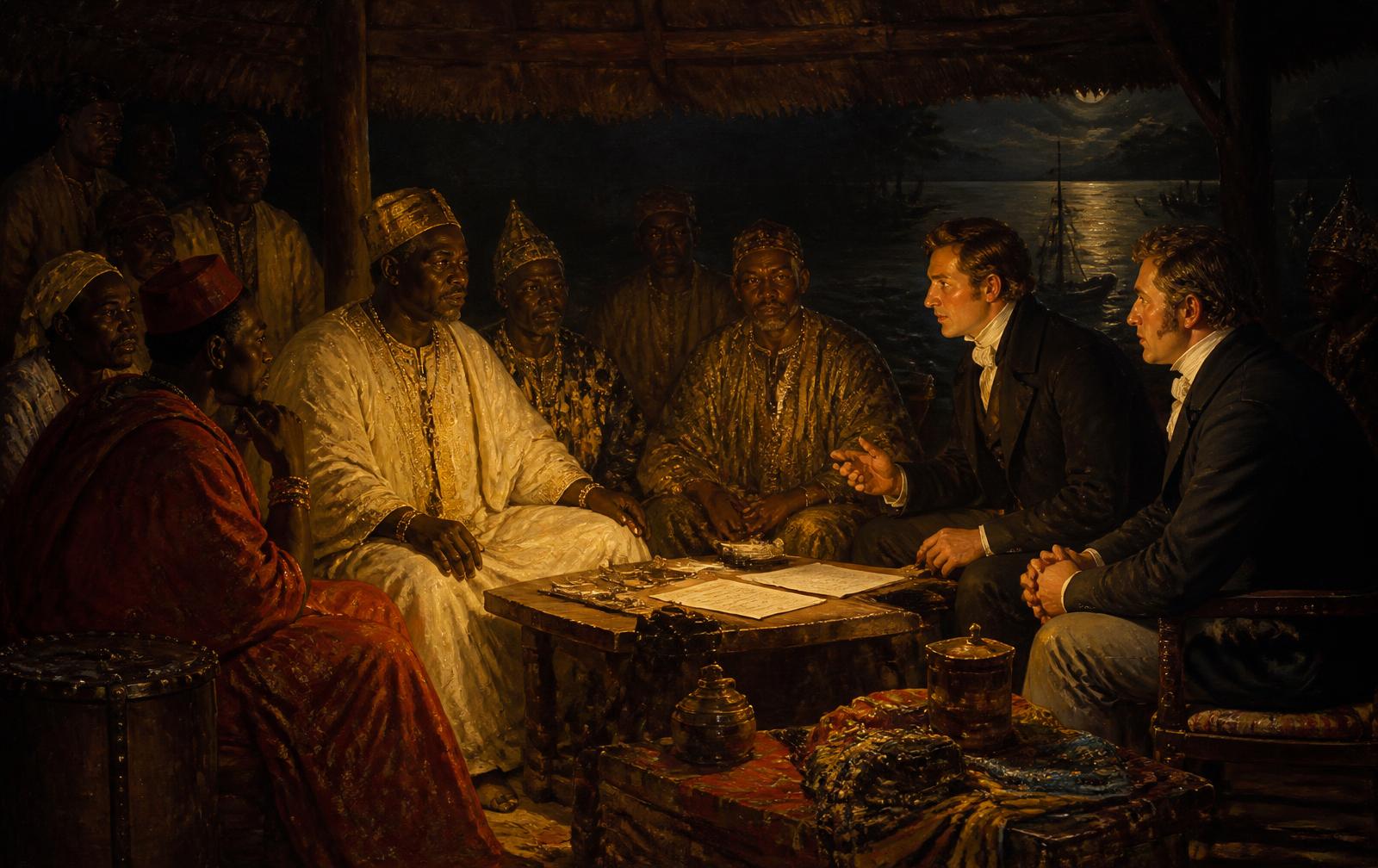
The Grain Coast as a Political Mosaic
When the agents of the American Colonization Society first anchored off Cape Mesurado in December 1821 aboard the *Elizabeth*'s successor vessels, they arrived not upon a vacant shore awaiting improvement but upon a densely inhabited and politically layered stretch of the West African littoral that Europeans had for three centuries called the Grain Coast, so named for the malaguetta pepper, or "grains of paradise," that early Portuguese and later English traders carried home in the sixteenth and seventeenth centuries. This was no terra nullius. It was a region organized into a shifting constellation of chiefdoms, town confederacies, and ritual polities whose governance did not map neatly onto European categories of kingdom or nation but which nonetheless exercised real and enforceable authority over land, trade, and the movement of strangers. To understand what happened after 1822 — the treaty-making, the land cessions, the decades of friction and accommodation between Americo-Liberian settlers and indigenous polities — requires first setting aside the colonial fiction of an empty coast and reconstructing, as far as the fragmentary record allows, the world that already existed there (Holsoe 1971)(Massing 1985).
The coastal and near-interior peoples whom the settlers would encounter, negotiate with, fight, and eventually attempt to govern were principally the Dei, the Bassa, the Gola, the Vai, the Kru, the Mandingo (or Mande-speaking Manding traders and clerics), and the Kpelle, along with smaller polities such as the Grebo further along the coast and the De and Mamba clusters nearer the Mesurado estuary itself. Contemporary population estimates for the entire Grain Coast littoral in the early nineteenth century, however imprecise, suggest a resident indigenous population numbering well into the hundreds of thousands across the territory that would eventually be claimed, at least on paper, by the Liberian settlement — figures dwarfing by two orders of magnitude the several dozen surviving settlers who staggered ashore at Mesurado in the spring of 1822 after the ravages of fever had already claimed a substantial fraction of the original expedition (Ashmun 1826)(Shick 1980). Each of the coast's constituent groups possessed distinct linguistic affiliations, migration histories, and modes of political organization, yet they were bound together — and had been for generations before 1822 — by dense networks of trade, marriage alliance, tributary relationship, and shared participation in the region's great supra-ethnic institutions, above all the Poro and Sande societies. Ethnic boundaries on the Grain Coast, as Svend Holsoe's fieldwork among the Vai and Bo Massing's studies of the Bassa hinterland both make clear, were considerably more porous and situational than the fixed "tribal" categories that later colonial administrators, and indeed early Liberian officials, would impose upon them for census and taxation purposes (Holsoe 1971)(Massing 1985). A Vai town might contain Gola clients, a Bassa chief might trace matrilineal descent from a Dei lineage, and a single powerful trading family might operate simultaneously in Vai, Gola, and Mende idioms depending on the commercial context, shifting registers of self-identification as fluidly as they shifted trading partners.
The Vai themselves, concentrated along the coast and lagoon systems between the Mesurado estuary and Cape Mount, had migrated into the region from the Mandingo interior in waves traditionally dated to the fifteenth and sixteenth centuries, a migration history preserved in oral genealogies that Vai elders continued to recite well into the twentieth century and that Holsoe was able to cross-reference against Portuguese and English trading records reaching back to the 1600s (Holsoe 1971). The Dei, by contrast, appear in the documentary and oral record as a comparatively small but strategically situated people occupying the immediate environs of Cape Mesurado and the Mesurado River, their principal towns including those under the chiefs remembered as King Peter, King George, King Zolu Duma, King Long Peter, and King Governor — men whose combined authority over perhaps several thousand people nonetheless controlled the single most valuable natural harbor and defensible headland on this stretch of coast, a strategic fact not lost on Stockton, Ayres, or the naval officers who accompanied them in 1821 (Capemesurado 1821)(Huberich 1947).
Political authority among these peoples was rarely centralized in the manner of the great Sudanic states to the north and east — the Mali and Songhai successor polities whose memory persisted in Mandingo oral tradition and whose Islamic scholarly culture had migrated south along trade routes over preceding centuries. Instead, governance on the Grain Coast operated through a layered system of town chiefs, or "kings" in the parlance of European traders and later American settlers, whose authority was checked, supplemented, and in matters of customary law frequently superseded by councils of elders, secret society leadership, and clan heads whose consent was required for any binding decision affecting land or war. The paramount chieftaincies that would later sign treaties with the American Colonization Society's agents — King Peter, King George, King Zolu Duma, King Long Peter, and others among the Dei and Gola polities around the Mesurado and Junk River basins — held real but bounded power. They could speak for their people in negotiations with strangers, receive and redistribute the goods exchanged in such negotiations, and mobilize warriors in defense of the town's interests, but they did not own land in the fee-simple sense that Eli Ayres and Robert Stockton, negotiating on behalf of the Colonization Society in 1821, appear to have assumed or at least represented to their sponsors in Washington (Capemesurado 1821)(Huberich 1947). The instruments exchanged at that December 1821 negotiation reportedly included some six muskets, several kegs of tobacco and gunpowder, quantities of cloth, beads, iron bars, rum, and assorted trade goods valued by the society's own later reckoning at scarcely more than three hundred dollars, a sum that Colonization Society partisans defended as a customary token of alliance-making but that critics both then and since have identified as wildly disproportionate to the roughly thirty-six miles of coastline and adjoining interior that the society's documents claimed to have acquired in perpetuity (Huberich 1947)(Sawyer 1992). This mismatch in legal imagination — a chief's customary authority to permit use of land construed by American negotiators as authority to alienate title to it permanently — would become one of the most consequential and enduring sources of conflict in the settlement's first decades, and its roots lie squarely in the incommensurability of the two systems of land tenure that met at Cape Mesurado in December 1821.
Land, Lineage, and the Meaning of Custody
Nothing separated the political economy of the Grain Coast polities from that of their American colonizing counterparts more fundamentally than the meaning of land itself. In the lineage-based systems that prevailed among the Dei, Gola, Bassa, Kpelle, and Vai, land was not a commodity subject to individual ownership and sale but a trust held by the living generation on behalf of ancestors and unborn descendants, administered by lineage heads and town chiefs who allocated usufruct rights to farming families but who could not, in customary theory, permanently sever the connection between a particular kin group and its ancestral territory (Massing 1985)(Beyan 1991). Rights to land derived from membership in a lineage or from incorporation into a host lineage through the reciprocal relationship known across the region as the "landlord-stranger" system, whereby a newcomer — whether an individual trader, a refugee family, or an entire migrating clan — petitioned an established landholding lineage for the right to settle and farm, offering in return tribute, labor, political loyalty, and often marriage alliances that over generations could transform strangers into quasi-indigenous clients and eventually into landlords themselves (Holsoe 1971).
It is this landlord-stranger idiom, so thoroughly documented by Holsoe for the Vai and by other scholars for neighboring peoples, that indigenous chiefs almost certainly believed they were invoking when they treated with Ayres and Stockton at Cape Mesurado, and later with subsequent Colonization Society agents such as Jehudi Ashmun, who assumed the colonial agency after the death of the society's first appointed agents to yellow fever within weeks of the expedition's 1822 arrival, a mortality event so severe that of the initial party of some eighty-eight settlers and agents who had sailed on the *Elizabeth* in January 1820 and the reinforcing party that followed in 1821, a substantial majority perished of fever within the first year, with some accounts placing early mortality among the pioneering settler cohort above fifty percent before the colony achieved even minimal demographic stability (Ashmun 1826). From the vantage of King Peter and the other Dei and Gola signatories, the December 1821 agreement — extracted, by most credible accounts, under considerable duress and at gunpoint, with Stockton reportedly holding a pistol to King Peter's head during the final negotiating session — likely represented an extension of landlord-stranger reciprocity: the granting of settlement rights to a new client community in exchange for goods, ongoing tribute, and alliance, not an irrevocable transfer of sovereign title over the Cape and its surrounding territory in the fee-simple terms that the society's charter documents and subsequent Liberian constitutional instruments would claim (Capemesurado 1821)(Huberich 1947)(Sawyer 1992). This is a point on which the historical record remains genuinely contested and must be treated as such rather than resolved by fiat in either direction. The American Colonization Society's own promotional literature and the depositions later collected in its published proceedings insist upon a voluntary and comprehensive cession; oral historical evidence collected among Dei and Gola descendants generations later, together with the internal logic of regional land tenure practice, supports a reading in which the local signatories believed themselves to be extending a customary and revocable grant of habitation rather than permanently divesting their lineages and descendants of their ancestral patrimony (Sawyer 1992)(Beyan 1991)(Burrowes 2016).
The subsequent decades of low-intensity warfare, treaty renegotiation, and land disputes between the settler government and neighboring indigenous polities — conflicts that punctuate the entire settlement period from Ashmun's 1822 battles at Fort Hill, in which perhaps thirty settlers armed with a handful of cannon repelled a far larger Dei and Gola force estimated by Ashmun's own account at several hundred combatants, through the repeated hostilities of the 1830s and 1840s along the St. Paul and Junk Rivers — are best understood as the long unfolding of this original interpretive collision rather than as episodic breaches of a settled agreement (Ashmun 1826)(Shick 1980). Later Liberian governments, faced with the same interpretive gap, would resort repeatedly to further "purchase" agreements throughout the 1830s, 1840s, and beyond, negotiated by successive colonial agents and later republican officials with Gola, Kpelle, and Bassa chiefs along the expanding frontier of settlement, each new agreement in effect ratifying the same landlord-stranger logic that indigenous signatories had employed from the outset even as the settler state's own legal instruments continued to describe these transactions in the absolutist language of Euro-American property law (Huberich 1947)(Const 1839)(Const 1847). These figures, however approximate, underscore that the settlement's founders confronted not a static or passive population but societies already engaged in continuous adaptation to Atlantic market pressures, disease environments, and internal political competition long before 1822 (Massing 1985)(Moses 1996). Even the region's demographic profile bore the marks of these overlapping commercial and political systems: mortality from endemic malaria, yellow fever, and periodic smallpox outbreaks was substantial among both indigenous and immigrant populations, but indigenous communities possessed generations of accumulated immunity and pharmacological knowledge, including quinine-adjacent bark preparations and other herbal prophylactics administered by specialist healers, that partially explains why Grain Coast populations sustained themselves demographically across centuries of disease burden in ways the newly arrived American settlers, wholly unacclimated, initially could not (Massing 1985)(Shick 1980).
Poro, Sande, and the Architecture of Supra-Village Authority
If chiefly authority on the Grain Coast was bounded and consultative, the deeper architecture of social control and cultural transmission across ethnic lines rested with the Poro society for men and its female counterpart, the Sande (known among some Gola and Vai communities as Sande or Bundu), institutions whose reach cut across the linguistic and political boundaries separating Dei from Gola from Vai from Kpelle and bound the entire coastal-forest region into an overlapping web of shared ritual obligation (Holsoe 1971)(Massing 1985). Poro functioned simultaneously as a male initiation system, typically requiring boys to spend an extended period, in some documented instances lasting up to three or four years for a full "bush school" cycle, in secluded forest camps where they received instruction in craft skills, oral law, martial training, and the esoteric knowledge reserved for initiated men; as a judicial and legislative body empowered to adjudicate disputes that individual town chiefs could not resolve; as a mechanism for regulating trade and warfare between towns, including the imposition of the so-called Poro "sasswood" ordeal and other ritualized means of establishing truth in contested cases; and as a repository of esoteric religious knowledge whose masked spirit-figures, the great forest spirits that emerged during initiation seasons, carried an authority that superseded ordinary chiefly power precisely because it was understood to derive from ancestral and supernatural rather than merely political sources.
Because Poro initiation camps recruited boys across village and even ethnic lines, and because senior Poro officials — the zoes, as they were titled among several of these peoples — often held standing that transcended any single town's political hierarchy, the society functioned as a genuine supra-village government in matters ranging from the negotiation of peace between warring towns to the regulation of prices in regional trade to the enforcement of customary law regarding land, marriage, and inheritance. A chief who defied a Poro ruling risked not merely social censure but the withdrawal of the ritual legitimacy that underwrote his authority to rule at all, a sanction with teeth sufficient to bring even powerful town rulers into line. Sande performed an analogous function for women, controlling female initiation — likewise organized around extended bush-school seclusion often lasting a period of months to several years depending on the locality and era — regulating marriage practices, and wielding independent authority over matters of female fertility, healing, and moral discipline that no male chief, however powerful, could override. European traders and later American settlers who dealt only with visible "kings" and "headmen" routinely underestimated or entirely missed this deeper layer of governance, a failure of comprehension that persisted well into the Liberian republic's own dealings with its indigenous hinterland populations throughout the nineteenth century and beyond, and one that scholars of the region's ritual institutions have identified as a recurring structural blindness in both colonial and postcolonial Liberian statecraft (Massing 1985)(Beyan 1991).
This blindness carried practical consequences for the settlers almost from the moment of their arrival. Colonization Society agents negotiating land cessions or seeking redress for stolen goods or violence against settlers frequently found themselves unable to secure durable agreements because the town chief with whom they treated lacked the unilateral authority to bind his community on matters that Poro elders considered within their own jurisdiction, a recurring source of settler frustration recorded in Ashmun's correspondence and in the later administrative records of the colony, which repeatedly complain of chiefs who "promised" one thing in negotiation only to see their communities act otherwise once Poro consultation had run its course (Ashmun 1826)(Shick 1980). The society's failure, or refusal, to engage with Poro and Sande as genuine governing institutions in their own right — treating them instead as exotic curiosities of "heathen" custom to be tolerated at best and suppressed at worst by missionary influence — represents one of the clearest instances in which American colonizationist ideology, with its Christian civilizing premises, actively impeded the settlers' own stated goal of achieving stable and mutually comprehensible relations with their indigenous neighbors (Staudenraus 1961)(Beyan 1991).
Literacy, Islam, and the Vai Syllabary
Against any characterization of the pre-1822 Grain Coast as a region without indigenous literate traditions, two distinct and significant literacy cultures flourished there well before the arrival of the American colonists. The first was the Islamic scholarly tradition carried south along trans-Saharan and trans-Sudanic trade routes by Mandingo (Mande-speaking Manding, often called Mandinka or Malinke in adjacent literatures) traders and clerics, whose ancestors had participated in the great Islamic scholarly centers of the Western Sudan associated with the Mali and Songhai empires. By the early nineteenth century, Mandingo communities scattered through the Grain Coast interior and at trading towns such as Bopolu, which by the 1820s had grown into a substantial multi-ethnic entrepôt under the leadership of the Condo confederation and its ruler Sao Boso, sometimes rendered Bòsó, maintained Quranic schools, Arabic literacy among their clerical class, and networks of religious and commercial correspondence that linked the coast to the broader Islamic world of the Western Sudan (Massing 1985). Bopolu itself, situated at the strategic junction of trade routes linking the coast to the interior savanna, drew a resident and transient population that contemporary estimates placed in the low thousands, encompassing Mandingo, Gola, Vai, Kpelle, and Dei residents and traders under a single, if loosely structured, political authority whose reach and diplomatic importance the American colonial agents came to recognize only gradually over the ensuing decades (Massing 1985)(Brooks 1972).
These Mandingo Muslim traders, often organized in diaspora communities analogous to the Dyula trading networks documented elsewhere in West Africa, served as crucial intermediaries in the long-distance trade in kola, cloth, salt, and captives that connected the coastal Grain Coast peoples to interior markets, and their literacy in Arabic script gave them a documentary and commercial sophistication that later surprised American settlers who arrived expecting to encounter no literate Africans at all. Correspondence, contracts, and even amulets inscribed with Quranic verses circulated within these networks, and Mandingo clerics were sought out by non-Muslim chiefs throughout the region for their perceived ritual and legal expertise, further extending Islamic literate culture's reach well beyond the Mandingo population itself and into Vai, Gola, and Kpelle communities that remained otherwise attached to indigenous religious practice (Massing 1985).
The second, and in scholarly terms more remarkable, literacy tradition was the Vai syllabary, an indigenous writing system developed among the Vai people of the coastal region between the Mano and Gallinas rivers. While the syllabary's formal invention is conventionally dated to the 1830s and associated with the Vai scholar Momolu Duwalu Bukele, its emergence drew upon a preexisting Vai intellectual culture of mnemonic and pictographic recording, oral historical specialization, and sustained exposure to both Arabic and Roman literacy through Mandingo Muslim contacts and coastal trade with literate Europeans and Americo-Liberians, such that its development in the years immediately following the period covered by this chapter should be understood as the culmination of literacy practices and cross-cultural intellectual exchange already well underway on the Grain Coast before 1822 rather than as a wholly discontinuous invention (Holsoe 1971). The syllabary, comprising well over two hundred distinct characters representing consonant-vowel syllables of the Vai language, spread rapidly enough among Vai communities in the decades after its invention that by mid-century American Protestant missionaries and Liberian officials alike remarked, with evident surprise, upon encountering Vai correspondence, business ledgers, and even historical chronicles rendered in the new script, a development that some missionary observers regarded as a providential opening for gospel translation and others regarded with unconcealed alarm as evidence of indigenous intellectual self-sufficiency that might resist rather than welcome American Christian tutelage (Holsoe 1971)(Staudenraus 1961).
The existence of the Vai script, one of the very few instances of an indigenous sub-Saharan African script created independently of Arabic or European models, stands as durable evidence against any historiography that would cast the pre-colonial Grain Coast as bereft of intellectual sophistication or documentary capacity, and it complicates in useful ways the American colonizationist narrative, prevalent in the Colonization Society's own publications and in the correspondence of agents like Ashmun, that cast the indigenous population as uniformly without letters and in need of American Christian tutelage (Ashmun 1826)(Staudenraus 1961). It is worth emphasizing that this literate sophistication long predated, and existed entirely independently of, the American Colonization Society's own educational apparatus, the schools and mission stations that the society and its allied denominational boards would later establish at Monrovia, Bassa Cove, and other settlements beginning in the later 1820s and 1830s, institutions whose own founding rhetoric routinely and inaccurately claimed to be introducing literacy to a coast that had, in fact, sustained multiple literate traditions for generations (Shick 1980)(Staudenraus 1961).
The Kru, the Bassa, and Coastal Maritime Labor
Distinct in social organization from their inland and northerly neighbors, the Kru-speaking peoples of the coast further south and east of Cape Mesurado — and the closely related Grebo further along the shore — had by the early nineteenth century developed a highly specialized maritime labor economy that made them indispensable to European and American shipping operating along the entire West African coast. Kru canoemen, prized for their skill in surf navigation through the dangerous coastal bars that made direct European access to shore difficult without local pilotage, worked as hired crew, cargo handlers, and intermediaries aboard slaving vessels, legitimate trading ships, and later the very colonization vessels that carried settlers to Liberia. Contemporary ship captains' accounts and the later testimony gathered by British and American naval officers describe individual Kru headmen contracting crews of a dozen or more men at a time for wage labor along stretches of coast running from the Kru heartland east past the Gold Coast and occasionally as far as the Congo, with wages typically paid in trade goods, cloth, and, later in the century, in coin, and with contracts negotiated through recognized headmen who took a customary share of the collective wage in exchange for organizing and vouching for the crew (Brooks 1972).
Kru political organization, like that of the Dei and Gola to their north, rested on town-based councils of elders rather than centralized kingship, but the Kru distinguished themselves further by an elaborate system of age-grade organization, in which men progressed through successive statuses tied to periods of labor migration, marriage, and eventual assumption of elder authority within the home town, and by a strong cultural aversion, noted repeatedly in the contemporary record, to enslavement of their own people, even as individual Kru men readily hired themselves out for wage labor on foreign vessels and at coastal factories, a distinction between voluntary wage labor and chattel slavery that Kru communities themselves insisted upon and that surprised many European observers accustomed to conflating the two (Brooks 1972)(Massing 1985).
The Bassa, occupying the coastal and riverine territory around the St. John and Benson rivers to the immediate south and east of the Mesurado settlements, maintained a political structure similarly organized around town chiefs and lineage heads, with the Poro society exercising comparable supra-village authority, and with an economy strongly oriented toward the production and export of camwood — a valuable red dyewood harvested from the interior forests and floated or carried to coastal factories for sale to European and American traders, where it commanded prices that fluctuated over the first half of the nineteenth century but that by mid-century typically ranged in the vicinity of twenty to forty dollars per ton delivered to coastal factors, a substantial sum that made camwood one of the most consistently valuable of the region's legitimate export commodities — alongside rice cultivation, palm oil and palm kernel production, and participation in the regional slave trade both as suppliers and, at times, as targets of raiding by more heavily armed neighboring or interior polities (Massing 1985)(Brown 1941). The Gola, situated in the forested interior behind the Vai and Dei coastal zone, controlled some of the most productive rice-growing land in the region and were renowned as formidable warriors whose raiding parties supplied captives into the coastal slave-trading networks even as Gola towns themselves periodically fell victim to raids launched by rival Gola factions or by allied Vai and Mandingo slaving interests (Holsoe 1971)(Massing 1985). The Kpelle, occupying territory further into the forested interior, maintained an agricultural economy centered on rice and were drawn into coastal trade networks primarily as suppliers of foodstuffs, ivory, and captives moving toward the coast through intermediary Gola and Mandingo traders, participating in the regional economy without, for the most part, direct contact with European vessels before the nineteenth century's advance, though their goods and captives reached the coast regularly enough through relay trade that Kpelle-produced rice and Kpelle-supplied captives figured meaningfully in coastal commercial accounts even in the absence of direct Kpelle-European contact.
The Atlantic Commercial Complex: Slaves, Camwood, Ivory, Rice, and Palm Products
The Grain Coast that the American colonists encountered in 1822 was already, and had been for well over two centuries, thoroughly integrated into Atlantic commercial circuits, even though the coast's own export volume in the transatlantic slave trade proper had historically been smaller than that of the Windward Coast further west or the Bight of Benin and Bight of Biafra to the east (Brooks 1972). The region's participation in the slave trade intensified markedly in the eighteenth and early nineteenth centuries, particularly after the British Parliament's Slave Trade Act of 1807 and the subsequent 1808 American prohibition on the importation of slaves drove much illegal trading activity toward less patrolled stretches of coastline, of which the lagoon-and-river complex known as the Gallinas — sometimes rendered Galinhas, after the Portuguese word for the guinea-fowl abundant there — became one of the most notorious remaining hubs of slave export on the entire West African coast well into the 1840s (Mouser 2010)(Brooks 1972).
The Gallinas slaving system, centered on the network of lagoons and river mouths just north and west of Cape Mount, operated through an alliance of local Vai and Gallinas-area chiefs — among whom the ruler remembered in the literature as King Siaka (Shiakar) exercised particular influence in the early nineteenth century, commanding tribute and trading rights over a coastal stretch that at the height of his authority in the 1820s and 1830s extended across multiple river mouths and dozens of subordinate towns — and a cadre of resident or itinerant European and mixed-race slave factors, most famously the Spaniard Pedro Blanco, whose barracoons at the mouth of the Gallinas River processed thousands of captives annually for export to Cuba and Brazil during the peak years of the illegal trade in the 1820s through 1840s, with some contemporary estimates suggesting that in peak years the Gallinas complex alone may have exported several thousand captives annually, each vessel typically carrying several hundred enslaved persons crowded into holds for the six-to-eight-week middle passage to Havana or Brazilian ports, at a mortality rate during passage that even by the reduced standards of the post-1807 illegal trade frequently exceeded ten to fifteen percent of those embarked (Mouser 2010). Similarly, the demographic weight of the illegal slave trade upon the Grain Coast's own indigenous societies deserves emphasis: even setting aside the captives drawn from further inland and merely transshipped through Gallinas barracoons, coastal chiefs' participation in supplying captives from war, judicial punishment, and debt pawnship drew directly upon the Vai, Gola, and Bassa populations themselves, producing a persistent demographic drain whose social costs, measured in lost labor, disrupted lineages, and the perpetual threat of raiding, shaped daily political calculation across the region in ways the American settlers, arriving with abolitionist convictions but limited grasp of local realities, took years to appreciate fully (Mouser 2010)(Massing 1985). This system depended on precisely the landlord-stranger reciprocity structures already described: Blanco and his fellow factors operated as resident strangers under the protection and license of local Vai and Gallinas landholding authorities, to whom they paid substantial tribute — often reckoned in the trade goods, firearms, and rum that constituted the standard currency of coastal commerce — and with whom they frequently intermarried, cementing commercial alliances through kinship in a pattern entirely continuous with older, non-slaving forms of coastal trade diplomacy (Mouser 2010)(Holsoe 1971). It was against this entrenched and heavily capitalized slaving complex, situated only a short distance up the coast from the incipient American settlement at Cape Mesurado, that the infant Liberian colony would define much of its early self-justifying ideology, casting itself, not without genuine conviction among many of its Black American founders, as an outpost of Christian commerce and abolition planted deliberately to interdict and ultimately supplant the slave trade in its immediate vicinity (Staudenraus 1961)(Shick 1980).
Beyond the slave trade, the so-called legitimate commerce of the Grain Coast in this period comprised a diversified export economy well suited to the region's ecology. Camwood, prized in Europe for the red dye extracted from its heartwood, was harvested in the forested interior, most heavily in Bassa and Kpelle territory, and floated or headloaded to coastal factories for export in substantial quantities throughout the first half of the nineteenth century, with individual coastal factories along the St. John and Mesurado rivers reporting camwood exports running into the hundreds of tons annually by the 1830s and 1840s as American and British commercial houses expanded their purchasing operations (Brown 1941)(Massing 1985). Ivory, sourced from the forest elephant populations of the interior, moved through the same middleman networks toward coastal ports, commanding prices that made it, pound for pound, among the most valuable of the region's legitimate exports, though aggregate volumes remained modest compared to camwood and palm products given the increasing scarcity of elephant populations within convenient trading range of the coast even by the early nineteenth century. Rice, the great subsistence staple of virtually all the coast's agricultural peoples and cultivated with particular skill by Gola and Vai farmers in both upland and mangrove-swamp variants, occasionally entered export trade to supply passing ships and neighboring coastal settlements, including, crucially, the new American colony itself, which depended heavily in its earliest and most vulnerable years on rice and other foodstuffs purchased or extracted from neighboring indigenous farmers, a dependency that gave those farmers real, if underappreciated, leverage over the settlement's survival, particularly during the repeated food crises of 1822 and 1823 when indigenous chiefs' willingness or refusal to sell rice at the Mesurado market could mean the difference between adequate provision and near-starvation for the fledgling colony (Ashmun 1826)(Burrowes 2016). Palm oil and, somewhat later in the century, palm kernels rounded out the export complex, harvested from the wild oil palm groves that flourished throughout the coastal and near-coastal zone and increasingly sought by British and American commercial houses as industrial demand for vegetable oils grew through the middle decades of the nineteenth century, with palm oil exports from the broader Grain and Windward coasts climbing markedly from the 1830s onward as Liverpool and American soap and candle manufacturers expanded their purchases, a trend that would eventually help finance a portion of the settler colony's own government revenues through export duties levied at Monrovia and the outlying settlements (Massing 1985)(Brooks 1972).
Coastal Middlemen and the Grammar of Landlord-Stranger Exchange
The commercial system that bound the Grain Coast to Atlantic markets, whether in captives or in camwood and palm oil, could not have functioned without an intricate class of coastal and riverine middlemen — chiefs, traders, and their extended kin networks — who controlled access to interior supply lines and who insisted, as a matter of both economic self-interest and customary right, that any foreign trader, missionary, or would-be settler operate within the landlord-stranger idiom already described. This system, thoroughly documented in Holsoe's analysis of Vai political economy and corroborated in the broader regional literature, required strangers seeking to trade, settle, or pass through a landholding lineage's territory to secure the sponsorship of a recognized local landlord, who would vouch for the stranger's conduct, mediate disputes on the stranger's behalf, receive tribute or trading fees in exchange for this protection, and bear responsibility if the stranger's presence caused harm to the host community (Holsoe 1971).
This was the framework through which King Peter, King George, and the other signatory chiefs at Cape Mesurado almost certainly understood their December 1821 dealings with Stockton and Ayres, and it was a framework the American colonizationist project, whatever its founders' intentions, proved either unable or unwilling to honor on indigenous terms once the settlement gained sufficient strength to dictate its own terms instead (Capemesurado 1821)(Sawyer 1992). The tension between an African system in which strangers acquired rights through ongoing tributary and social relationship rather than through one-time purchase, and an American system imported wholesale from the plantation South and reinforced by the legal instruments of the Colonization Society's charter, would recur throughout the settlement period in disputes over customs duties charged to indigenous traders passing through settler-controlled ports, in repeated indigenous complaints that promised annual payments (the "grounds rent" or "dashes" the society had promised in exchange for land) went unpaid or were unilaterally reduced, and in the settlers' own increasingly proprietary language regarding land that indigenous signatories had granted, in their own understanding, only provisionally (Huberich 1947)(Shick 1980)(Burrowes 2016). Later documentary evidence gathered from the society's own agents indicates that annual payments to signatory chiefs, when they were made at all, amounted to only a small fraction of the goods' nominal value promised at signing, and that successive Liberian administrations after the 1847 declaration of independence progressively reduced or reinterpreted these obligations even as they simultaneously expanded the territorial claims premised upon the original 1821 cession (Decl 1847)(Const 1847)(Huberich 1947).
The middleman function performed by figures such as Sao Boso at Bopolu, or by the various Vai and Gallinas chiefs who brokered access between interior suppliers and coastal factors, extended well beyond simple commercial intermediation into the realm of diplomatic mediation between the American settlement and the wider indigenous polity, a role that men like Sao Boso and, somewhat later, the Vai leader Gatumba performed repeatedly in negotiating settlements to armed conflicts between the colony and neighboring peoples during the 1820s and 1830s, leveraging precisely the credibility and cross-cutting kinship ties that their commercial middleman status had built up over preceding decades (Massing 1985)(Shick 1980).
British Abolition, Naval Suppression, and the Precedent of Sierra Leone
No account of the Grain Coast on the eve of American settlement can be complete without situating it against the immediately adjacent and directly precedential case of Sierra Leone, whose colony at Freetown had been established in 1787 by British abolitionists as a refuge for London's Black poor, and subsequently reinforced by waves of Black Loyalist settlers from Nova Scotia in 1792, numbering some twelve hundred emigrants, and Jamaican Maroons in 1800, numbering approximately five hundred and fifty, before passing into direct Crown administration in 1808 as part of Britain's broader abolitionist project following the 1807 Slave Trade Act (Brooks 1972)(Mouser 2010). Freetown became, over the ensuing decades, the principal base for the Royal Navy's West Africa Squadron, whose vessels patrolled the coast intercepting slave ships and landing tens of thousands of "recaptives" — Africans liberated from seized slaving vessels, with cumulative totals landed at Freetown across the first half of the nineteenth century estimated at well over sixty thousand individuals — who were resettled in and around Freetown and who, together with their Krio (Creole) descendants, developed a distinctive Anglophone, Christianized, commercially active society that stood as both a working model and, for the somewhat later American Colonization Society, an implicit rival template for what an African colonization project organized around Black resettlement and abolitionist commerce might accomplish (Everill 2013).
The British naval patrols mandated after 1807, and reinforced through a succession of bilateral suppression treaties Britain negotiated with other slave-trading powers over subsequent decades, fundamentally reshaped the commercial geography of the entire Grain and Windward coasts, pushing the surviving illegal slave trade into stretches of coastline, such as the Gallinas, that lay beyond convenient naval reach and that consequently grew more heavily fortified and more lucrative even as overall regional slave exports gradually declined across the first half of the nineteenth century (Mouser 2010). It was into this transitional and volatile commercial environment — a coast simultaneously subject to escalating international abolitionist pressure and still deeply enmeshed in illegal slaving profit, already familiar with one major precedent in organized Black Atlantic resettlement at Freetown, and governed by indigenous polities whose landlord-stranger customs had already absorbed generations of foreign traders, missionaries, and naval officers — that the American Colonization Society's ships arrived at Cape Mesurado in 1821 and 1822, carrying settlers whose own leaders, including Ashmun, explicitly invoked the Sierra Leone precedent as both inspiration and cautionary example in their private correspondence and public reports back to the society's headquarters (Ashmun 1826)(Staudenraus 1961).
Comparative traffic figures compiled by later historians of the Sierra Leone Squadron indicate that in the peak years of the 1820s and 1830s, Royal Navy vessels intercepted on the order of several dozen slave ships annually along the wider West African coast, a rate of interdiction sufficient to raise significantly the costs and risks of the trade without eliminating it outright, and one that channeled a disproportionate share of surviving illegal traffic toward exactly those stretches of coast, like the Gallinas, where local political fragmentation and the absence of any comparable British or American colonial administration left slave factors comparatively free to operate under indigenous protection (Mouser 2010)(Everill 2013). The American Colonization Society's founders were keenly, if selectively, aware of these dynamics: the society's early promotional literature repeatedly framed the projected Liberian settlement as an American analogue to the Sierra Leone experiment, capable of projecting an equivalent moral and eventually naval presence along a stretch of coast that British patrols could not by themselves fully suppress, even though the society in its first decades possessed nothing remotely resembling the naval capacity that gave the Sierra Leone model its interdictive teeth (Staudenraus 1961)(Shick 1980).
Historiographical Stakes and Conclusion
The historiographical stakes of this chapter's reconstruction are not merely antiquarian. How one characterizes Grain Coast political organization, land tenure, and commercial sophistication on the eve of 1822 directly shapes how one subsequently narrates the legitimacy, coercion, and mutual accommodation embedded in the settlement's founding transactions. An older colonizationist historiography, exemplified in the celebratory tone of much nineteenth-century American writing on Liberia, treated the region's peoples as politically fragmented, economically primitive, and essentially without sovereign standing to resist or meaningfully negotiate the terms of American settlement, a characterization that served the ideological purposes of a movement whose leadership, from the society's Washington headquarters down to its resident agents on the coast, needed to represent the Cape Mesurado transaction as both legally sound and morally uncomplicated in order to sustain donor confidence and congressional goodwill for a colonization project that depended heavily on continued private and, at times, federal financial support (Staudenraus 1961). A corrective historiography developed across the later twentieth century by scholars including Holsoe, Massing, Brooks, and more recently Burrowes, Everill, and Clegg, has instead documented sophisticated, if decentralized, systems of governance, land custody, literacy, and Atlantic commercial engagement that render the 1821 Mesurado agreement and its successors acts of negotiation between unequal but nonetheless mutually cognizant parties, in which indigenous polities pursued their own strategic interests — access to trade goods, alliance against rival African polities, potential leverage against slave-raiding neighbors — even as they were subject to profound coercion, misrepresentation, and, over subsequent decades, outright military conquest (Clegg 2004)(Burrowes 2016)(Everill 2013).
This reconsideration matters as well for how the chapters that follow will treat the settler-colonial state that emerged from these transactions. The Constitution the settlers eventually adopted for their fledgling commonwealth in 1824, and the more elaborate instrument the independent republic promulgated in 1847, both proceeded from the premise of a clean, comprehensive, and permanent territorial title inherited from the founding cessions, a premise this chapter's reconstruction should lead readers to regard with considerable skepticism (Const 1824)(Const 1847)(Decl 1847). The repeated indigenous wars of the settlement period, the perennial disputes over customs collection from indigenous traders at settler-controlled river mouths, and the eventual, still more coercive processes of territorial expansion and political incorporation that characterized Liberian governance of its hinterland populations through the remainder of the nineteenth century and well into the twentieth, all trace their proximate origins to the interpretive gulf between American and indigenous conceptions of land, sovereignty, and obligation examined in this chapter (Liebenow 1987)(Sawyer 1992)(Akpan 1973).
This chapter's reconstruction of the pre-1822 Grain Coast is offered in service of that second, more demanding historiographical tradition, and the chapters that follow will trace how its central institutions — chiefly authority, Poro and Sande governance, lineage land custody, and the landlord-stranger grammar of exchange — shaped, constrained, and were in turn transformed by the arrival of the American colonization project. Understanding the Grain Coast on its own terms, as a region of genuine political complexity, literate sophistication in more than one tradition, and deep Atlantic commercial entanglement stretching back over centuries, is thus not a preliminary courtesy owed to the region's indigenous peoples before the "real" narrative of Liberian settlement can begin. It is the necessary foundation without which the settlement narrative itself, and the recurring conflicts that punctuate it, cannot be properly understood at all. Taken together, these strands of evidence — chiefly polity, ritual governance, dual literacy, maritime labor specialization, and deep Atlantic market integration — compose a portrait of the Grain Coast substantially at odds with the colonizationist imagination of an empty or primitive shore, and it is against this substantially reconstructed portrait that the remainder of this book's narrative of settlement, negotiation, and conflict must be read (Holsoe 1971)(Massing 1985)(Burrowes 2016).
Notes on Sources
This chapter draws its ethnographic and political reconstruction primarily from Svend Holsoe's field and archival scholarship on Vai social and political organization (Holsoe 1971) and from Bo Massing's regional synthesis of Grain Coast economy and society (Massing 1985), supplemented by George Brooks's work on Kru maritime labor and coastal commerce (Brooks 1972) and Bruce Mouser's detailed reconstruction of the Gallinas slaving complex (Mouser 2010). Robert Brown's account of camwood and riverine commerce along the Bassa coast (Brown 1941) informs the treatment of legitimate trade. The contested question of what the 1821 Cape Mesurado agreement meant to its indigenous signatories is treated through Charles Huberich's documentary compilation (Huberich 1947), the original agreement text (Capemesurado 1821), Jehudi Ashmun's own contemporaneous account (Ashmun 1826), and the critical reappraisals of Amos Sawyer (Sawyer 1992) and Carl Patrick Burrowes (Burrowes 2016). Bronwen Everill's comparative study of Sierra Leone and Liberia (Everill 2013) and the abolitionist historiography synthesized by P. J. Staudenraus (Staudenraus 1961) inform the treatment of British naval suppression and the Freetown precedent. Claude Clegg's methodological example (Clegg 2004) shapes this chapter's insistence on holding African agency and American coercion in the same interpretive frame, while the constitutional texts of 1824 and 1847 and the 1847 Declaration of Independence (Const 1824)(Const 1847)(Decl 1847) anchor the chapter's closing discussion of how founding-era land claims were subsequently formalized. Where the archival record is silent or contradictory, as it frequently is regarding indigenous testimony, this chapter has favored explicit acknowledgment of uncertainty over false synthesis.