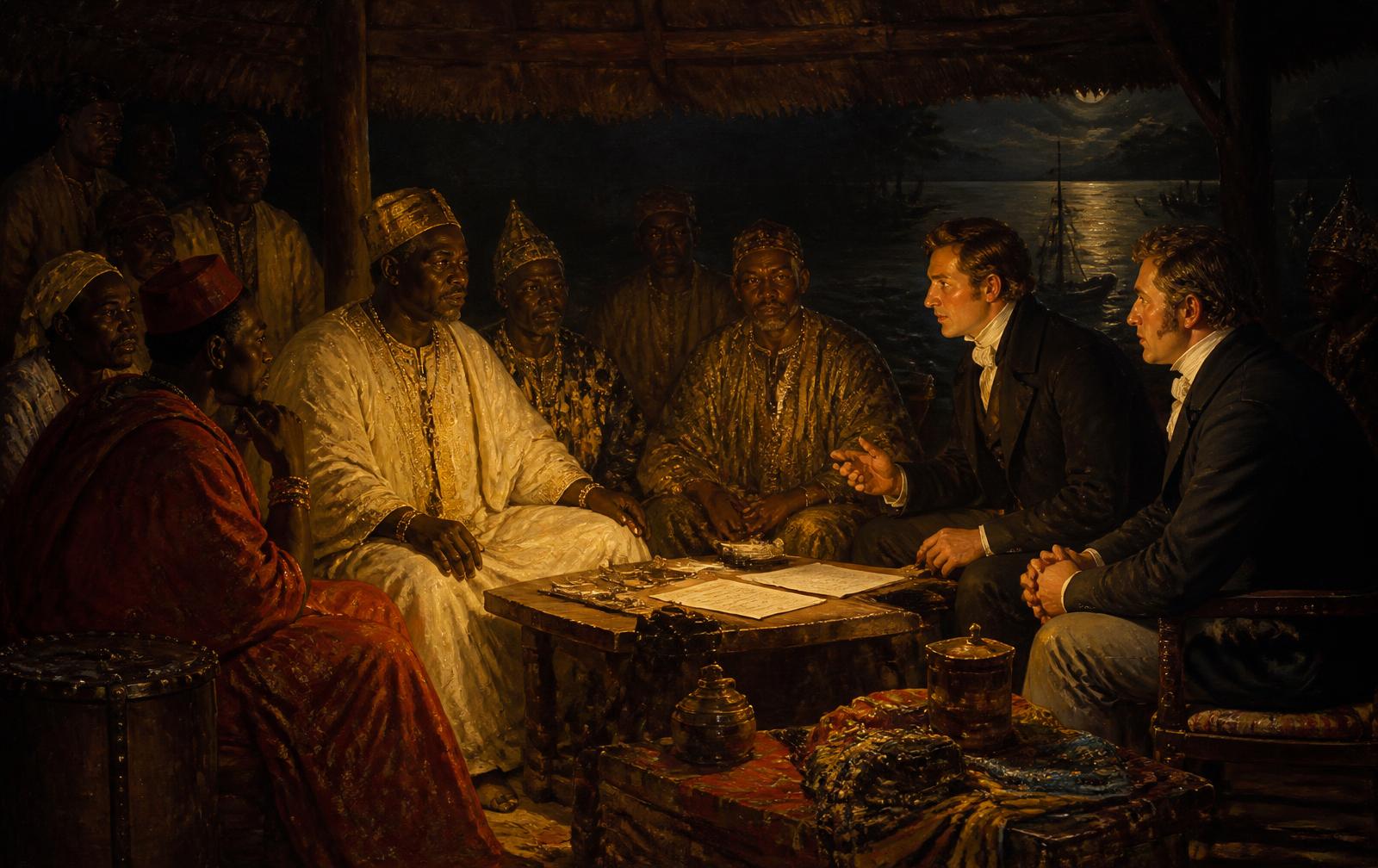
The Anchorage at Mesurado
By the second week of December 1821, the schooner carrying the agents of the American Colonization Society had already spent months probing the Grain Coast for a landing that local rulers would countenance and that American backers would judge defensible and commercially promising. The final negotiation at Cape Mesurado did not occur in isolation; it followed weeks of preliminary contact at Sherbro Island, where the first colonists under the Reverend Samuel Bacon and the naval agent Eli Ayres had wintered miserably in 1820 and 1821, suffering the fever mortality that decimated the original expedition (Shick 1980). That failure, and the death of Bacon and of the Society's other agents, forced the survivors southward along the coast in search of a healthier and more secure site, a search that brought them into the orbit of the trader and sometime intermediary of Cape Mesurado, and into contact with the Dei-speaking polities who controlled the peninsula and the lagoon behind it. The move to Mesurado was thus not a single dramatic landing but the culmination of an itinerant, improvisational process of coastal reconnaissance conducted under conditions of extreme demographic loss among the American party, a fact that historians such as Tom Shick and Charles Huberich treat as essential context for understanding why the December negotiation proceeded with such haste and under such asymmetries of desperation and demand (Shick 1980)(Huberich 1947).
The specific sequence of days in December 1821 is not fully recoverable from a single continuous journal, and scholars have had to reconstruct the chronology from the correspondence of Ayres, the log entries and later recollections associated with Lieutenant Robert Field Stockton of the United States Navy schooner Alligator, and the documentary compilation later assembled by Huberich from Society archives (Huberich 1947)(Acs papers). What can be established is that negotiations moved between Bassa Cove, where an earlier and less consequential set of overtures had been made to coastal leaders, and Cape Mesurado itself, where the more decisive discussions with the ruler remembered in the American record as King Peter took place. Bassa Cove functioned less as the site of final agreement than as a staging ground and as a location where Stockton and Ayres tested the terrain of local politics, gauging which headmen held authority sufficient to make a grant credible to other Americans and to rival colonization schemes then competing for footholds on the coast, including the parallel and much better documented British-associated ventures at Sierra Leone (Mouser 2010). The movement from Bassa Cove to the Cape over the course of several days in mid-December reflects the fact that authority over the Mesurado peninsula was not vested in a single sovereign in the European sense but was distributed among a cluster of Dei and neighboring Gola-affiliated leaders whose relative standing the Americans only partially understood (Holsoe 1971).
The Parties at the Table
The American side of the transaction was represented by two men whose authority to act was itself a matter of layered delegation. Eli Ayres held a commission as agent of the American Colonization Society, charged with locating and securing a site for the resettlement of free Black Americans and recaptured Africans landed under the 1819 Slave Trade Act, and his correspondence from the period reveals a man acutely conscious of the Society's impatience after the Sherbro debacle and of his own precarious authority to bind an organization located an ocean away (Ashmun 1826)(Acs papers). Robert Field Stockton, by contrast, held no civil commission from the Society at all; he was a serving United States naval officer whose vessel had been assigned to suppress the slave trade along the coast and who inserted himself into the negotiation with a degree of force that later commentators, both sympathetic and critical, have found difficult to reconcile with any strict theory of civilian colonization diplomacy (Staudenraus 1961). Stockton's presence matters because it blurs from the outset the line between a private philanthropic and colonizing society's land purchase and an act backed by the implicit and, on the traditional but contested account, sometimes explicit coercive power of the United States government, a blurring that recurs throughout the documentary record of early Liberian land transactions and that later Liberian and American historians have treated as central to any assessment of the transaction's legitimacy (Burin 2005)(Beyan 1991).
On the African side, the principal signatory remembered in Society records as King Peter is described inconsistently across the surviving sources, a fact that itself testifies to the limits of American understanding of Dei political structure. He appears variously as a paramount figure of standing sufficient to alienate the peninsula and as one headman among several whose consent had to be supplemented by that of other leaders, sometimes named in later compilations as King George, King Zoda, King Long Peter, King Governor, and King Jimmy, a roster that Huberich reproduced from later Society correspondence and that has been treated with due caution by subsequent scholars because it appears to conflate signatories from more than one occasion and possibly more than one location (Huberich 1947). The Dei political order of the early nineteenth century, as reconstructed by Svend Holsoe and by George Brooks from oral tradition, coastal trade records, and comparative ethnography, was structured around lineage-based town leadership and shifting alliances among Dei, Gola, and Vai speakers who exercised overlapping and often contested claims to land and to control of trade routes running from the interior to the coast (Holsoe 1971)(Brooks 1972). In such a system, the notion that a single "king" could convey exclusive and permanent title to a defined tract of land, in the fee-simple sense assumed by the American negotiators, had no ready equivalent, and this mismatch between the parties' respective theories of what was being transacted is among the most consequential features of the December 1821 encounter, a point developed at length in the legal-historical literature that examines Liberian land tenure in the nineteenth century (Sawyer 1992)(Mcdaniel 1995).
Witnesses to the transaction, so far as the surviving compilations record them, included members of Stockton's ship's company and at least one interpreter whose name is inconsistently rendered across accounts, alongside coastal intermediaries who had long served as brokers between European and American traders and the Dei and Vai polities of the Mesurado and Grand Cape Mount region (Huberich 1947)(Massing 1985). The role of such intermediaries, often men of mixed coastal trading lineage fluent in the pidgin commercial English that had developed over two centuries of Atlantic trade on the Grain Coast, was indispensable and yet is treated in the American record almost as an afterthought, a asymmetry of documentary attention that historians of the coastal trade, notably Bruce Mouser and Adam Jones, have identified as a recurring feature of Euro-American accounts of African land cessions along the entire Upper Guinea Coast (Mouser 2010)(Jones 1983).
The Inventory of Goods
The material terms of the December 1821 agreement, as reconstructed from Society records and repeated in subsequent nineteenth-century compilations, consisted of a package of trade goods whose exact itemization varies slightly between sources but which converges on a recognizable set of categories long familiar in West African coastal commerce. The inventory is generally given as including a quantity of muskets, kegs of gunpowder, bars or rolls of tobacco, strings and boxes of beads, casks of rum, bolts of cloth of varying quality, mirrors or looking-glasses, pairs of shoes, kegs of nails, and a number of iron cooking pots, together with smaller quantities of miscellaneous hardware and cutlery (Huberich 1947)(Brown 1941). This assemblage should be read against the long history of the Atlantic trade goods complex on the Grain and Windward Coasts, in which firearms and gunpowder functioned simultaneously as instruments of hunting, warfare, and prestige display, while tobacco, rum, cloth, and beads operated within established regional systems of exchange value that had been calibrated over generations of contact with Portuguese, Dutch, English, and American traders (Massing 1985)(Jones 1983). Contemporary and near-contemporary American estimates placed the total value of the goods exchanged at roughly three hundred dollars, a figure that appears repeatedly in Society-derived accounts and that Charles Huberich reproduced from the documentary record he assembled in the 1940s, though he and later scholars caution that the valuation reflects American commercial accounting rather than any independent assessment of the goods' worth within the regional trade economy of the Grain Coast, where the same commodities might command different relative values depending on scarcity, season, and the political leverage of the parties involved (Huberich 1947).
Set against this modest consignment, the territory nominally conveyed was, on the most expansive reading of the agreement's language, immense: a coastal strip running from the vicinity of Grand Cape Mount southward to the Junk River, an distance of several dozen miles, extending inland by a like distance, which if taken literally would encompass several thousand square miles of forest, farmland, and river systems inhabited by numerous Dei, Gola, Vai, and Bassa communities who were not party to the negotiation at all (Huberich 1947)(Holsoe 1971). The disproportion between three hundred dollars in trade goods and a claim to so vast an inland territory has been a recurrent subject of moral and legal scrutiny since at least the late nineteenth century, and it sits at the center of any assessment of the transaction's character. Historians sympathetic to the colonization project, including earlier Society-affiliated chroniclers, tended to treat the valuation question as beside the point, arguing that African land was customarily alienated for what Europeans regarded as nominal considerations throughout the history of Atlantic contact, and that the substantive consideration lay not merely in goods but in the promise of ongoing trade relations, protection, and access to American and British shipping that a permanent settlement was expected to bring (Ashmun 1826). Later and more critical historiography, by contrast, including the work of Amos Beyan and of Claude Clegg, situates the Mesurado transaction squarely within a broader pattern of undercompensated and often coerced land alienation that characterized European and American dealings with West African polities in this period, and stresses that the American negotiators possessed and were prepared to use superior armed force, most visibly embodied in Stockton's naval vessel and its guns, as a background condition that shaped whatever consent Peter and his associated signatories ultimately gave (Beyan 1991)(Clegg 2004).
The Boundary Language and Its Vagueness
The territorial description attributed to the December 1821 agreement, as it survives in the documentary tradition assembled principally through Huberich's compilation and repeated in subsequent American and Liberian historical writing, describes the ceded land as running from Grand Cape Mount to the Junk River and extending inland "the same distance," a formula whose imprecision has attracted sustained scholarly comment (Huberich 1947). Grand Cape Mount lies at a considerable remove north of the Mesurado peninsula, and the Junk River lies to the south; the coastal distance between these two points, even calculated generously, could be reckoned in different ways depending on whether one measured a straight line, a coastal traverse, or a customary reckoning in days of travel, a category of measurement far more familiar to the Dei and Vai signatories than any American surveyor's mile. The clause specifying an inland extension "the same distance" compounds the ambiguity, since it implies a rectangular or trapezoidal cession whose interior boundary was never surveyed, never marked by any physical monument known to either party, and never reconciled with the actual settlement patterns, farming rights, and sacred sites of the Dei, Gola, and Vai communities who lived within the nominally described tract (Holsoe 1971)(Sawyer 1992). No contemporary map accompanied the transaction, and the American negotiators, whose own knowledge of the coastal geography beyond the immediate vicinity of the Cape was rudimentary, had every incentive to construe the boundary language expansively once settlement began and the colony's territorial appetite grew (Brown 1941).
This vagueness was not merely an accident of imprecise draftsmanship; it reflects a deeper incommensurability between the American legal expectation that a land cession be defined by fixed and permanent boundaries susceptible to later enforcement, and the African expectation, as reconstructed from comparative ethnographic and historical evidence on Dei and Vai land tenure, that rights to land were relational, usufructuary, and embedded in ongoing social and political relationships rather than reducible to a bounded parcel alienated once and for all (Holsoe 1971)(Mcdaniel 1995). Amos Sawyer's analysis of indigenous Liberian political and land systems argues persuasively that no Dei or Vai leader in 1821 would have understood himself to be permanently extinguishing his community's relationship to land in the sense the American document purported to record, and that the very notion of a final, written, and permanent conveyance was itself an imposition of a foreign legal category onto a negotiation that the African parties likely understood as the establishment of a trading and residency arrangement, analogous to earlier accommodations reached with British, French, and earlier American traders and missionaries along the same coast, rather than as an irrevocable cession of sovereignty (Sawyer 1992). This interpretive gap did not remain latent; it erupted into open conflict within months of the settlement's establishment, as King Peter and allied leaders mounted armed resistance in 1822, an episode addressed in the following chapter, but its roots lie squarely in the ambiguities of the December 1821 negotiation itself (Shick 1980)(Beyan 1991).
Translation, Interpreters, and the Problem of Consent
Because no verbatim transcript of the spoken negotiation survives, and because the written instrument was composed in English by the American party for the American party's purposes, the question of what precisely was communicated to Peter and his fellow signatories, and in what language, is one of the most consequential and least resolvable problems in the historiography of the founding. The Grain Coast of the early nineteenth century possessed a well-established coastal trade pidgin, built up over some three centuries of contact with Portuguese, Dutch, English, and eventually American vessels, and it is likely that communication proceeded through some combination of this trade pidgin, gesture, and the mediation of coastal go-betweens whose own command of English varied and whose own interests in the transaction, whether as prospective trading partners of the new settlement or as rivals to other coastal brokers, cannot be assumed to have been neutral (Mouser 2010)(Jones 1983). Huberich's compilation preserves references to interpreters but does not name them with confidence or describe their qualifications, and no independent Dei or Vai-language record of the negotiation exists against which the English text can be checked, a documentary asymmetry that is itself a historiographical fact of the first importance: the entire surviving record of what was agreed in December 1821 is a record produced by one party to the transaction, in that party's own language and according to that party's own legal conventions (Huberich 1947).
This asymmetry bears directly on the vexed question of consent. American and later Liberian nationalist historiography, including much of the commemorative literature produced around Liberian centennial observances, tended to treat Peter's signature, or mark, as unambiguous evidence of a freely negotiated agreement between sovereign equals, an interpretation that dovetailed with the broader ideological project of presenting the Liberian founding as a peaceful, providentially sanctioned transaction rather than a conquest (Guannu 1980)(Akpan 1973). Scholars working from a more critical vantage, including Claude Clegg and Amos Beyan, have argued instead that whatever verbal assurances were exchanged, the presence of Stockton's warship and the demonstrated willingness of the American party to employ force, evident both in the tenor of Ayres's own later correspondence and in the armed clash that followed the settlement's establishment, means that the negotiation cannot be characterized as free bargaining among equals in any meaningful sense, even if it also cannot be reduced to simple fraud, since there is no reliable evidence that Peter and his associates were deceived about the basic fact that Americans wished to establish a permanent settlement on the peninsula (Clegg 2004)(Beyan 1991). The more defensible position, and the one this chapter adopts, is that consent in the December 1821 transaction was neither wholly absent nor freely given in any liberal contractual sense, but was negotiated under conditions of profound asymmetry in military power, linguistic mediation, and legal framework, conditions that rendered the resulting instrument simultaneously a genuine, if constrained, act of African diplomatic accommodation and an act of imposition whose long-term consequences the signatories could not have fully anticipated (Sawyer 1992)(Mcdaniel 1995).
An Anglo-American Instrument in a Non-Documentary Legal Culture
The document that emerged from the December negotiations, insofar as its terms can be reconstructed, took the form recognizable to any student of Anglo-American conveyancing: a description of parties, a recitation of consideration, a description of the land conveyed, and the marks or signatures of the granting parties, a form directly descended from English common-law deed conventions that the American Colonization Society's agents, several of whom, including Ayres, had some acquaintance with American legal and commercial practice, would have regarded as the obviously appropriate instrument for recording a land transaction (Huberich 1947)(Const 1824). This choice of legal form was not a neutral technical matter but an act of cultural imposition in its own right, since it presupposed a theory of property, of individual or corporate sovereign authority to alienate land, and of the binding, permanent, and exclusive character of written instruments that had no counterpart in Dei or Vai customary practice, where land relationships were typically negotiated orally, renewed periodically, and embedded in reciprocal obligations rather than fixed in a single act of transfer memorialized on paper (Holsoe 1971)(Sawyer 1992). In this sense the Mesurado agreement belongs to a broader category of instruments produced throughout the era of European and American expansion into non-documentary societies, in which the very act of reducing a negotiation to a written deed served to translate a fluid and relational African transaction into the fixed, litigable, and enforceable terms of Western property law, terms that could then be invoked, as they later were by the Liberian government itself, to defend territorial claims against subsequent indigenous resistance and against rival European colonial powers (Sawyer 1992)(Gershoni 1985).
It is worth noting that the Society and its agents were not wholly innocent of the instrument's function in this respect. The American Colonization Society had, since its founding in 1816 and 1817, operated in a transatlantic environment in which British antislavery and colonization circles, and British commercial and territorial interests on the neighboring Sierra Leone coast, provided both a model and a competitive pressure, and the drafting of a formal deed at Mesurado should be read partly as an effort to produce a document that would carry weight in Anglo-American diplomatic and commercial circles, capable of being cited against British claims or French incursions, rather than as a document whose primary audience was the Dei and Vai communities whose land it purported to describe (Staudenraus 1961)(Campbell 1971). The later use of the Mesurado deed and its successor agreements in disputes with British Sierra Leone officials and in the eventual assertion of Liberian sovereignty before European powers in the 1840s confirms that the instrument's chief long-term function was international and diplomatic rather than locally regulative, a fact that further underscores its character as an Anglo-American legal artifact operating within, but not organically arising from, the political and legal world of the Mesurado peninsula (Shick 1980)(Const 1847).
What the Text Establishes and What It Cannot
A careful reading of the surviving documentary tradition permits certain conclusions and forecloses others. It is reasonably well established that some negotiation occurred at or near Cape Mesurado in mid-December 1821, involving Ayres and Stockton on the American side and a figure or figures identified as King Peter, along with other Dei leaders, on the African side, and that goods of the general categories enumerated above changed hands in connection with an understanding that Americans would be permitted to settle on the peninsula (Huberich 1947)(Ashmun 1826). It is also reasonably well established that the settlers who arrived in the following weeks understood themselves to possess a legal title sufficient to warrant permanent occupation and the exclusion of other claimants, and that this understanding rapidly proved contested by at least some of the very leaders who had participated in or been implicated by the negotiation, culminating in the armed confrontations of 1822 (Shick 1980)(Beyan 1991). What the surviving text cannot establish, however, is a precise and mutually agreed territorial boundary, a stable and unambiguous identity and authority of all African signatories, a verified faithful translation of the instrument's terms into a form intelligible to those signatories, or a settled and shared theory, on both sides, of what kind of relationship, temporary accommodation or permanent alienation of sovereignty, had actually been created (Sawyer 1992)(Mcdaniel 1995)(Holsoe 1971).
This evidentiary gap is not merely a matter of insufficient documentation that better archival work might resolve; it is structural, arising from the fact that one party to the transaction operated within an oral, relational, and non-documentary legal culture whose own record of the event, transmitted through Dei and Vai oral tradition rather than through Society archives, has survived far less systematically in the written historical record than the American account, though ethnohistorical work by Holsoe and others has sought to recover elements of it (Holsoe 1971). The historian is therefore obliged to treat the December 1821 agreement not as a transparent window onto a discrete historical event whose terms can be recovered in full, but as a contested artifact whose very form, an Anglo-American deed purporting to convey sovereign title over territory inhabited by tens of thousands of people who had no part in its drafting, already encodes the central tension of the Liberian founding: an act that was, from the American and eventually the Americo-Liberian settler perspective, an exercise of hard-won Black self-determination in the aftermath of centuries of enslavement, and that was simultaneously, from the perspective of the Dei, Gola, and Vai communities of the Mesurado peninsula, an imposition of foreign sovereignty backed by superior force and validated by a legal instrument whose categories were not their own (Beyan 1991)(Clegg 2004)(Moses 1996). Later Liberian constitutional and political development, from the Commonwealth period through the Declaration of Independence in 1847, would repeatedly return to and build upon the foundational claim first asserted in the Mesurado deed, even as the indigenous polities whose land it described continued, well into the twentieth century, to contest the terms on which that claim rested (Const 1847)(Decl 1847)(Liebenow 1987).
Notes on Sources
This chapter relies principally on Charles Huberich's monumental documentary compilation, which remains the fullest available assembly of the deeds, correspondence, and related materials bearing on the Mesurado transaction, though its early twentieth-century editorial choices and occasional conflation of distinct episodes require careful handling (Huberich 1947). Jehudi Ashmun's early narrative, though written from within the colonization project and therefore interested rather than disinterested testimony, supplies texture on the settlers' own understanding of the agreement (Ashmun 1826). Tom Shick's demographic and social history situates the negotiation within the broader Sherbro failure and subsequent resettlement, while Amos Beyan and Claude Clegg provide the critical reassessment of coercion and consent that anchors this chapter's interpretive stance (Shick 1980)(Beyan 1991)(Clegg 2004). Svend Holsoe's ethnohistorical scholarship on Dei and Vai political and land systems, supplemented by Amos Sawyer's legal-institutional analysis, underlies the discussion of boundary vagueness and non-documentary land tenure (Holsoe 1971)(Sawyer 1992). George Brooks, Adam Jones, and Bruce Mouser inform the treatment of coastal trade goods, interpreters, and the regional commercial context of the Grain Coast (Brooks 1972)(Jones 1983)(Mouser 2010). Where sources conflict or where the record is silent, this chapter has preferred explicit acknowledgment of uncertainty over speculative reconstruction.
Bassa Cove Reconsidered: The Preliminary Days
The historiographical habit of collapsing the entire negotiation into a single dramatic scene at Cape Mesurado obscures the fact that the American party's approach to the coast in the first half of December 1821 was itself a negotiated, contingent process shaped by prior failures and by the specific maritime logistics of Stockton's schooner. The Alligator's movements along the coast in this period were governed as much by the exigencies of anti-slave-trade patrol duty, which was Stockton's primary naval assignment, as by any settled itinerary for colonization diplomacy, and the record suggests that the vessel's presence off Bassa Cove in the days immediately preceding the Mesurado negotiation served a dual purpose: it allowed Ayres to renew contact with headmen in that vicinity with whom earlier, less consequential discussions about a possible settlement site had already occurred, and it allowed Stockton to demonstrate, in advance of the decisive negotiation at the Cape, the kind of naval presence that would later weigh so heavily on the encounter with Peter and his allies (Huberich 1947)(Staudenraus 1961). Bassa Cove lies some considerable distance south and east of Cape Mesurado, and the leaders with whom the Americans spoke there were not, on the available evidence, the same individuals who eventually signed the Mesurado instrument, a distinction obscured in some of the popular retellings that treat "the coast chiefs" as an undifferentiated bloc rather than as a set of distinct polities with their own internal politics and their own reasons for entertaining or resisting American overtures (Holsoe 1971).
It is important to stress that the Bassa Cove discussions did not by themselves produce any binding cession; rather, they appear to have functioned as a kind of diplomatic reconnaissance, in which the Americans tested local reactions to the proposal of a permanent settlement, gauged the willingness of Bassa-area leaders to countenance American shipping and trade, and gathered intelligence, however imperfect, about the relative authority of leaders further up the coast at Mesurado. Ayres's later correspondence, as reproduced by Huberich, suggests that the American party moved on from Bassa Cove because they judged the Cape Mesurado peninsula, with its defensible headland, its access to the St. Paul River system, and its proximity to established trade routes running into the interior, to be both more strategically valuable and more readily obtainable than a settlement further south (Huberich 1947)(Brown 1941). This judgment reflected a set of priorities, defensibility against future European rivals, access to interior trade in ivory, camwood, and eventually palm oil, and proximity to the recaptured-African depot that the settlement was also meant to serve, that had relatively little to do with the wishes or interests of the Dei and Gola communities who actually inhabited the Cape, and everything to do with the Society's own strategic calculations as an organization competing for legitimacy and resources within the broader Atlantic antislavery and colonization movement (Staudenraus 1961)(Campbell 1971).
The shift from Bassa Cove to the Cape also illuminates a recurring feature of the entire negotiating sequence: the Americans' reliance on a shifting cast of coastal intermediaries who accompanied or guided the schooner from one anchorage to the next, individuals whose own trading relationships with communities along this stretch of coast predated the American arrival by years or decades and who possessed local knowledge that Ayres and Stockton lacked entirely. These intermediaries, sometimes identified only obliquely in the American record as "interpreters" or "guides," were themselves embedded in networks of Afro-European trade that had operated along the Grain Coast since at least the seventeenth century, networks whose logic of brokerage, commission, and reciprocal obligation shaped the terms on which the Mesurado negotiation was eventually concluded in ways the American principals only partially grasped (Mouser 2010)(Jones 1983).
The Days at the Cape: Sequence and Escalation
Once the American party arrived off Cape Mesurado itself, the negotiation proper appears to have unfolded over a period of several days rather than in a single sitting, a pattern consistent with West African diplomatic convention, in which substantial agreements were customarily reached only after repeated meetings, the exchange of preliminary gifts, and consultation among the several parties whose interests were affected (Holsoe 1971)(Sawyer 1992). The American sources, filtered as they are through Ayres's own retrospective account and through the later compilations of Society officials eager to present the transaction in the most favorable light, describe an initial reluctance on the part of Peter and the other Dei leaders to grant the Americans permanent settlement rights, a reluctance that the American narrative attributes variously to the influence of European slave traders operating in the vicinity, who had obvious commercial reasons to discourage the establishment of an antislavery colony astride their trade routes, and to the leaders' own uncertainty about the long-term consequences of admitting a permanent American presence (Huberich 1947)(Beyan 1991).
This reported reluctance is significant because it complicates any simple narrative of straightforward consent freely and readily given. If the American record itself preserves testimony to initial refusal, subsequent negotiation, and eventual agreement only after repeated meetings, then the process by which Peter and his associates arrived at their eventual signature or mark cannot be treated as a single instantaneous act of consent but must be understood as the product of sustained pressure exerted over several days, pressure that included the visible presence of Stockton's armed vessel anchored offshore throughout the proceedings. Accounts differ, and later retellings, including some produced by the Society itself for domestic American consumption, tend to dramatize the moment at which Stockton is said to have drawn a pistol or otherwise threatened Peter directly in order to compel his agreement, a episode that appears in various forms in nineteenth-century popular and denominational literature about the founding but that Huberich and subsequent professional historians treat with considerable skepticism, noting the absence of contemporaneous corroboration and the tendency of such stories to grow more dramatic with each retelling in the decades after the event (Huberich 1947)(Brown 1941). What is not in serious dispute, however, is that Stockton's presence, armed and naval, constituted an ever-present backdrop to the negotiation regardless of whether any single dramatic act of intimidation occurred, and that this backdrop alone was sufficient to distinguish the Mesurado negotiation from an encounter between parties of comparable coercive capacity (Clegg 2004).
The final days of the negotiation, on the reconstructed chronology, involved the settling of the specific terms, the assembly and transfer of the trade goods from the schooner's hold, and the production of the written instrument itself, a document that, on the balance of the evidence, was drafted by the American party in English and presented to the African signatories for their mark rather than jointly composed through a process of mutual drafting (Huberich 1947)(Sawyer 1992). The absence of any indication that the document was read back to the African signatories in a language they commanded, or that its precise legal implications, particularly its claim to permanent and exclusive alienation of sovereignty rather than a more limited grant of settlement and trading rights, were explained to them in terms they could evaluate, remains one of the most significant gaps in the historical record and one that bears directly on any assessment of the transaction's legitimacy (Mcdaniel 1995).
The Trade Goods in Regional Commercial Context
To understand what three hundred dollars in trade goods meant on the Grain Coast in December 1821, it is necessary to situate the transaction within the broader commercial economy of the Upper Guinea Coast, an economy that by the early nineteenth century had been shaped by roughly three centuries of intermittent but sustained contact with European and, increasingly, American traders. Firearms and gunpowder, prominent in the Mesurado inventory, had long been central to coastal trade precisely because they conferred military and hunting advantages that recipient polities prized highly, and their presence in the transaction should be read as evidence that the American negotiators understood, at least implicitly, the kind of goods most likely to secure African cooperation (Massing 1985)(Jones 1983). Tobacco and rum, likewise prominent, had become thoroughly embedded in coastal exchange and gift-giving protocols, often serving not merely as items of consumption but as tokens exchanged to open, sustain, or seal negotiations, a function that suggests the Mesurado goods were not simply a lump-sum payment for land in the American sense but were distributed, at least in part, according to customary protocols of gift exchange that accompanied any serious diplomatic negotiation on this coast (Brooks 1972).
Cloth, beads, mirrors, and small manufactured items such as nails and iron pots occupied a somewhat different commercial register, functioning as durable goods whose value derived both from their utility and from the prestige associated with imported manufactures, a prestige economy that Adam Jones and other historians of the Upper Guinea trade have documented extensively for the neighboring Sierra Leone and Windward Coast regions (Jones 1983). The inclusion of such items in the Mesurado inventory indicates an American awareness, likely derived from earlier trading experience along this coast, of the categories of goods that would be recognized as appropriate and valuable within local commercial convention, even as the overall scale of the consignment, valued by American reckoning at roughly three hundred dollars, was almost certainly far below what a comparable transfer of several thousand square miles of territory would have commanded had the transaction been evaluated according to any coherent theory of land value, whether American or African (Huberich 1947).
It is worth noting, however, that applying a strict American commercial valuation to the transaction risks importing anachronistic assumptions about how land itself was valued within Dei and Vai custom. If land was not conceived by the African parties as an alienable commodity possessing a market price in the first place, then the disproportion between the value of the goods and the notional market value of the land, striking as it appears from a modern vantage, may not fully capture how the transaction was understood by at least some of the African participants at the time, who may have understood themselves to be receiving valuable goods in exchange for permitting settlement and trade rather than in exchange for permanently extinguishing their community's relationship to the land in question (Sawyer 1992)(Holsoe 1971). This is not an argument for the fairness of the transaction, but rather a caution against assuming that both parties shared, even implicitly, a common metric of value against which the exchange can be judged. The undercompensation critique retains its force primarily because of what happened afterward, namely the American assertion of permanent, exclusive, and eventually sovereign title over the described territory, an assertion that went well beyond whatever the African signatories may have understood themselves to be granting (Beyan 1991)(Clegg 2004).
Comparative Perspectives: Sierra Leone and Other Coastal Cessions
The Mesurado transaction did not occur in a vacuum, and its terms bear close comparison to the earlier and better documented cessions through which the British Crown and the Sierra Leone Company had obtained land at Freetown and along the neighboring coast beginning in the 1780s and continuing through subsequent decades. Christopher Fyfe's foundational work and subsequent scholarship on Sierra Leone, echoed in the more general treatments by Bruce Mouser, demonstrate that British negotiators had likewise relied on written deeds executed with local Temne and other rulers, deeds whose boundary language was similarly vague, whose consideration was similarly modest relative to the territory described, and whose subsequent interpretation by British colonial authorities expanded steadily beyond what local signatories appear to have originally understood themselves to be granting (Mouser 2010). The American Colonization Society's agents, several of whom had direct or indirect knowledge of the Sierra Leone precedent, both as a model of successful Black resettlement and as a cautionary example of the friction that could arise between a colonizing power and the surrounding indigenous population, approached the Mesurado negotiation with this comparative experience in mind, and the formal resemblance between the Mesurado deed and earlier Sierra Leone cessions is unlikely to be coincidental (Staudenraus 1961)(Campbell 1971).
This comparative context matters for two reasons. First, it suggests that the vagueness of the Mesurado boundary language and the disproportion between goods and territory were not aberrations peculiar to inexperienced or unusually rapacious American negotiators, but were characteristic features of a broader Atlantic pattern of land cession diplomacy in which European and American parties consistently sought, and frequently obtained, written instruments whose terms could later be construed expansively regardless of the African signatories' original intent. Second, it suggests that the Dei and Gola leaders who negotiated with Ayres and Stockton in December 1821 were not approaching the transaction naively or in complete ignorance of Euro-American land-cession practice; the Grain Coast, no less than Sierra Leone, had been part of Atlantic trade networks for centuries, and its leaders had encountered European traders, missionaries, and occasional settlement schemes before, giving them some basis, however imperfect, for interpreting what the Americans proposed (Brooks 1972)(Holsoe 1971). This does not resolve the question of consent, but it does complicate any narrative that presents the African parties to the Mesurado negotiation as wholly unfamiliar with the general category of transaction being proposed, even if the specific and far-reaching legal claims that the Americans would later derive from the written instrument exceeded anything the African signatories are likely to have anticipated.
The Deed's Afterlife: Interpretation, Expansion, and Contest
The consequences of the December 1821 agreement's textual vagueness did not remain confined to the immediate aftermath of the negotiation but shaped the entire subsequent history of Liberian territorial expansion through the 1820s, 1830s, and 1840s. Successive Society agents, most prominently Jehudi Ashmun, who arrived at the colony in 1822 shortly after the violent confrontation with Peter's forces, invoked the Mesurado deed and its successor instruments to justify an expanding American claim to territory well beyond the immediate vicinity of the Cape, incorporating additional stretches of coastline and interior through further negotiations, purchases, and, on several documented occasions, renewed threats or applications of force against Dei, Gola, Bassa, and Kru communities who continued to contest the settlers' claims (Ashmun 1826)(Shick 1980). The pattern established at Mesurado, an imprecise written instrument, disputed by the very communities whose land it purported to describe, invoked expansively by the settler government to justify further territorial claims, recurred with only minor variation in subsequent land transactions throughout the Commonwealth period, and it fed directly into the territorial disputes that punctuated relations between the Liberian settlement and neighboring African polities for decades afterward (Mcdaniel 1995)(Sawyer 1992).
The legal status of the Mesurado deed itself became a matter of some importance once the Commonwealth of Liberia developed formal governing instruments of its own, beginning with the Constitution and frame of government adopted for the colony in 1824 and continuing through the more elaborate constitutional arrangements of subsequent years, which took for granted a territorial jurisdiction whose ultimate origin lay in the 1821 cession and its successors (Const 1824). When the independent Republic of Liberia adopted its own constitution in 1847, following the Declaration of Independence issued that same year, the territorial claims embedded in the founding land transactions were carried forward into the new republic's assertion of sovereignty, an assertion that Liberian statesmen would subsequently need to defend both against indigenous resistance from within and against the territorial ambitions of British and French colonial administrations pressing upon Liberia's borders from Sierra Leone and from the French possessions to the east (Const 1847)(Decl 1847). In this sense the interpretive afterlife of the Mesurado deed extended far beyond the immediate circumstances of December 1821, becoming a foundational, if legally fragile, building block in the construction of Liberian sovereign territory, one whose ambiguities were resolved, when they were resolved at all, not through renewed negotiation with the original signatories or their heirs but through the unilateral assertion of settler authority backed, as at the outset, by superior armament (Sawyer 1992)(Gershoni 1985).
Historiographical Debate: Reading the Founding Document
The interpretive stakes of how one reads the Mesurado agreement have shifted considerably across the nearly two centuries since the transaction occurred, tracking broader changes in the historiography of colonization, race, and African agency. Nineteenth-century American accounts produced within or in sympathy with the Colonization Society, including Ashmun's own narrative and subsequent Society publications, tended to present the transaction as a providential and essentially peaceful acquisition, minimizing the role of coercion and emphasizing instead the goods exchanged and the voluntary character of Peter's eventual agreement, a framing that served the Society's ongoing need to defend colonization against critics, both proslavery skeptics who doubted the colony's viability and Black American critics, including prominent free Black leaders, who from the outset questioned the Society's motives and suspected that colonization served chiefly to remove free Black Americans rather than to advance genuine self-determination (Staudenraus 1961)(Moses 1996).
Twentieth-century Liberian nationalist historiography, exemplified by writers such as Joseph Guannu and Monday Akpan working within a tradition concerned with establishing a usable national past for the independent republic, generally preserved much of this providential framing, treating the Mesurado agreement as the founding charter of a legitimate Black nation-state whose subsequent difficulties with indigenous populations were often folded into a broader narrative of nation-building rather than examined as a direct consequence of the founding transaction's own ambiguities and coercive elements (Guannu 1980)(Akpan 1973). This nationalist historiography served important purposes for a young state seeking international recognition and internal cohesion, but it has been substantially revised by later scholarship that draws more heavily on ethnohistorical and indigenous-centered sources.
The critical turn associated with scholars including Amos Beyan, Claude Clegg, and, in a related vein, Elwood Dunn and Svend Holsoe, has reframed the Mesurado agreement as a case study in the broader phenomenon of settler colonialism operating under an anti-slavery banner, arguing that the moral urgency of the antislavery cause, genuine as it was for many Society members and for the formerly enslaved and free Black settlers who risked their lives to cross the Atlantic, does not exempt the founding transaction from the coercive and exploitative dynamics that characterized contemporaneous European colonization elsewhere on the continent (Beyan 1991)(Clegg 2004)(Dunn 2001). This body of scholarship insists that indigenous Dei, Gola, Vai, and Bassa perspectives, however imperfectly recoverable, must be treated as constitutive of the history of the founding rather than as a peripheral complication to an otherwise settled American narrative, a methodological commitment that this book shares and that shapes the interpretive stance adopted throughout this chapter (Holsoe 1971)(Mcdaniel 1995).
A third strand of scholarship, associated with historians such as Carl Burrowes and, in a different register, Alexander Everill, has sought to hold both readings in productive tension, insisting that the settlers themselves, many of them recently freed from slavery or born into families only a generation removed from bondage, exercised a genuine and historically remarkable act of self-determination in crossing the Atlantic to build an independent Black polity, even as that polity's founding transaction with the Dei and Gola inhabitants of Mesurado reproduced many of the coercive features of the colonial land grabs the settlers themselves might, in other circumstances, have condemned (Burrowes 2016)(Everill 2013). This dual character, self-determination for one party achieved partly through imposition upon another, is not a paradox to be resolved in favor of one reading or the other but a structural feature of the founding that subsequent Liberian history, from the Commonwealth period through independence and beyond, would repeatedly confront and only partially reconcile (Campbell 1971)(Martin 1968).
Roberts, Continuity, and the Long Shadow of December 1821
Although Joseph Jenkins Roberts, who would become the colony's last white-appointed governor's successor as the first Black governor and subsequently the first President of the independent Republic of Liberia, played no direct role in the events of December 1821, his later career and correspondence, preserved in the collections of his papers used extensively by Liberian historians, reflect a settler political class that had internalized the Mesurado deed and its successors as the unquestioned legal foundation of Liberian territorial sovereignty (Roberts papers). Roberts's administration, and those of his immediate successors, continued the pattern established at Mesurado of negotiating further land cessions with interior and coastal polities under conditions of significant power asymmetry, even as the Liberian government simultaneously sought international recognition, most notably British recognition in 1848 and subsequent recognition by other European powers, on the strength of a territorial claim whose documentary origins in the 1821 transaction remained, on close inspection, as ambiguous as they had been at the outset (Shick 1980)(Gershoni 1985). This continuity is significant because it demonstrates that the interpretive and legal problems inherent in the December 1821 agreement were never simply resolved by the passage of time or by subsequent state-building; rather, they were absorbed into the institutional and legal fabric of the emerging Liberian state, where they continued to generate friction between the Americo-Liberian settler government and indigenous Liberian communities well into the twentieth century, a friction extensively documented in J. Gus Liebenow's later analysis of Liberian politics and the enduring settler-indigenous divide (Liebenow 1987).
The persistence of this friction underscores the central argument of this chapter: the paper produced at Cape Mesurado in December 1821 was neither a straightforward act of fraud nor a fully consensual agreement between equal sovereign parties, but a hybrid instrument, American in form, contested in substance, and consequential in ways that neither Ayres, Stockton, nor Peter and his fellow signatories could have fully foreseen. Understanding the Liberian founding requires holding this complexity steadily in view, resisting both the temptation to reduce the December 1821 agreement to a simple morality tale of villainy and victimhood and the equally mistaken temptation to treat it as an unproblematic charter of legitimate national sovereignty. It was, in the final analysis, a document produced at the intersection of two profoundly different legal and political worlds, and its ambiguities, textual, linguistic, and moral, would echo through the entire subsequent history of the Liberian state.